
The Manchurian Candidate
Update 915. Stop The Woke Police Special. #BeMorePorcupine.

Well done to England for (miraculously) getting through to the quarter finals of the World Cup and bad luck to the States for getting knocked out ( I am not entering into the President Trump Red Card issue 😀). And well done to all other countries who have qualified or will qualify and bad luck to those who got knocked out in the round of 16 ( carefully covering my readers from other countries!! 😀).
The news and views continue to flood in, so this is another very long one, dear readers.
Thanks as ever to my paid subscribers and to those who buy me a coffee. These updates do take up an enormous amount of work, so please consider becoming a paid subscriber.
Onwards with the Dusty,Nicola, Moodie and Rex Film Series 😀 Please keep the suggestions for films coming in but please check the list first which I am updating as we go along. Please send suggestions in the comments here at this link:
https://dustymasterson.substack.com/p/empire-of-light-dustys-film-series
The Manchurian Candidate is a 1962 American film directed and produced by John Frankenheimer.
During the Korean War, Soviet and Chinese soldiers capture a U.S Army platoon, taking them to communist China. Three days later, Sergeant Raymond Shaw and Captain Bennett "Ben" Marco return to UN lines. Upon Marco's recommendation, Shaw is awarded the Medal of Honour for saving his soldiers' lives in combat, though two men were killed. Shaw returns to the United States, where his mother, Eleanor Iselin, exploits his heroism to further the political career of her husband, Senator John Iselin. When asked to describe Shaw, two soldiers in his unit uniformly respond that "he is the kindest, bravest, warmest, most wonderful human being [they] have ever known." In actuality, Shaw is a strict, cold, unsympathetic loner hated by his men.
Frank Sinatra is Major Bennett Marco
Laurence Harvey is Raymond Shaw
Thanks to two wonderful readers for suggested pieces.
Some of the linked pieces below may be behind a paywall.
UK - The Conversion Practices Bill
As readers know we are following this appalling piece of legislation. I will be providing a compendium of all the pieces for paid subscribers in due course. Another excellent piece here, this time from Sonia Sodha on her substack:
The conversion practices bill: vibes-based legislating
Labour MPs are rallying in support of a dangerous bill that risks criminalising parents who don’t agree to their child’s social transition
Jul 06, 2026
The government published its draft conversion practices bill ten days ago. The bill was a manifesto commitment and purports to ban something bad - abusive conversion practices aimed at changing someone’s sexual orientation or transgender identity. If only that’s all there was to it.
The reality is that this bill is a Trojan Horse that smuggles in a whole host of dangerous unintended consequences that gender activists could use to pursue people who don’t comply with their ideological demands. First, that men who believe they are women should be treated as women for all purposes in society, and second, that gender-questioning children should be affirmed as trans and funnelled onto irreversible medical pathways that come with lifelong risks for their fertility, bone health and brain development.
Abuse, assault and coercive control are already criminal offences in England and Wales. The key question about this bill remains: what does this bill criminalise that isn’t already criminal and which ought to be criminalised? Its proponents - including government ministers - have not been sufficiently clear on this, a worrying sign of just how badly thought through it is. The research on which the draft bill is based - undertaken or commissioned by third-party campaigning organisations like Stonewall and Galop - is threadbare, and does not come close to establishing the extent to which there is a problem with specific conversion practices that should be, but are not, criminal under existing law. Meanwhile, the bill risks criminalising parents and child professionals who don’t accede to children’s demands to be recognised as the opposite sex, with significant chilling impacts, and in a way that represents an unacceptable incursion by the state into parent-child relationships.
The background
Gender activists who hold the quasi-religious beliefs that everyone has an inner ‘gender identity’; that trans people have a different gender identity from the reality of their sexed bodies; and that it is gender identity rather than the scientific fact of someone’s sex that determines whether or not they are a man or a woman, have long campaigned for a statutory ban on what they term ‘conversion therapy’.
For them, ‘conversion therapy’ goes beyond incredibly harmful - and already criminal - practices to try and change someone’s sexual orientation through assault, abuse or coercive control. It means trying to change someone’s ‘gender identity’. They believe that it is abusive not to immediately recognise or affirm a gender-questioning child who says they have a gender identity associated with the opposite sex. This belief is based on the false assertion that ‘gender identity’ is a fixed characteristic like sexual orientation. In fact, as highlighted by the independent review undertaken by the experienced paediatrician Hilary Cass, gender distress in children and young people - many of whom are autistic or grappling with their emerging same-sex attraction - is likely to be transient and naturally resolve in the majority of cases. Gender activists see the key thrust of the Cass review - that gender-questioning children should be treated through holistic, exploratory therapy that explores the underlying reasons why they may be experiencing distress related to their bodies, rather than just take it as read they will grow up to have a lasting trans identity in adulthood - itself as a form of ‘conversion therapy’. The former chief executive of Stonewall has appeared to openly endorse this view.
You cannot understand the conversion practices bill without understanding these roots. It is primarily a tool for campaigners to smuggle in the means to impose their ideology on the rest of society - an ideology that has harmed women and children through its erosion of sex-based rights - using the criminal law, under the guise of banning things that are already criminal. The pledge to criminally ban ‘conversion therapy’ in the Labour manifesto was made to keep these campaigners happy, not on the basis that there is a significant problem with abusive practices not covered by existing criminal statute. We can see this in the fact that the government’s draft impact assessment neither gives clear examples of conduct that should be but is not already criminal, nor establishes that there is a problem new legislation is needed to address.
The full piece is here:
https://soniasodha.substack.com/p/the-conversion-practices-bill-vibes
Kathleen Stock in Unherd comes from a slightly different angle:
The conversion paradox Today’s asexual could be tomorrow’s lothario
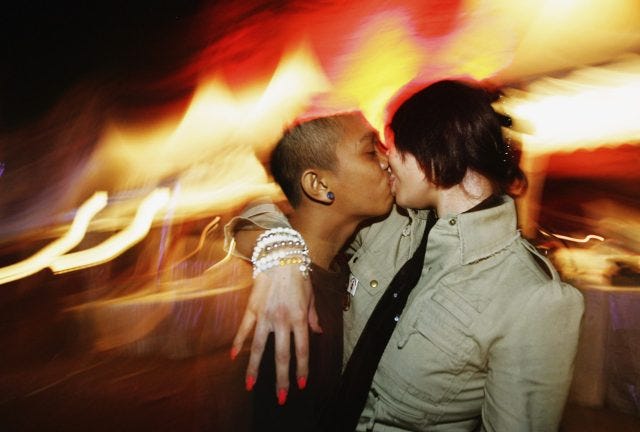
‘Nobody can tell now whether a current identity will stick; not even its owner.’ (Dimas Ardian/Getty)
3 Jul 2026
Like Aristotle, our Labour overlords take a firm line on the question of essence versus accident in the human soul. A desire to stuff your face with cake is fixable with injections. Ardent petrolheads can be bribed into buying electric cars. Reform voters can be shamed out of their political attraction to Nigel Farage. But a sexual orientation or gender identity is for life.
Such is the unstated implication of the Conversion Practices draft bill, published last week. Two supposedly core, immutable elements of the human person are identified, for which corrective drugs, bribes, or shaming are all presumed diabolical — though these are completely fine to use for more flexible attitudes elsewhere. To try to alter the pattern of someone’s sexual desires, by exerting psychological or emotional pressure or worse, risks becoming a “conversion practice”. The same goes for trying to dissuade someone from a heartfelt profession of gender identity. Past a certain threshold, the police and courts must get involved.
This bill is already receiving much hostile comment, both for its performative aspect — violent and abusive acts are already punishable — and its absurd overreach into understandably heated family discussions about life-changing hormones and surgery. Accompanying notes to the draft try to make a virtue of the chillingly authoritarian focus upon “verbal or non-violent physical acts”. Offences include practices causing “serious alarm and distress” and “serious harm to mental health”, both of which are too vaguely specified to protect loving parents from police investigation for speaking their mind. The wording is also unlikely to induce religious clergy to express honest and well-meant thoughts about the wisdom of homosexuality or medical transition. Thankfully, at least, there is a carveout for healthcare professionals, but it remains unclear why conversations perfectly acceptable in the doctor’s surgery or therapy space must be harmful at home or in church.
But not much has been said about one unexpected implication of the bill: that conversion practices involving straight people are just as harmful as those involving gay or trans ones. The intention to cause a heterosexual or “cis” person to become homosexual or trans is to be treated in just as draconian a manner as the inverse case. In theory at least, progressive parents who preach the gospel of gender affirmation a little too enthusiastically risk criminal investigation later, when their children have second thoughts — a possibility which, you have to admit, is darkly funny. The idea that there might also be criminal liability for the hundreds of lanyard-wearing youth workers out there, still working very hard to cement the idea of medical and social transition into deeply unworldly heads, is even more delicious.
But these enticing visions also point to an ambiguity at the heart of the draft legislation; namely, how are third parties supposed to know for sure that a professed sexual orientation or gender identity is permanent, as opposed to a temporary form of experimentation? It would be ironic if the first parent prosecuted for trying to “convert” her child from X to Y turned out later to have been right about the merely transitory presence of the X-ness all along. Unless authorities can answer this question, the law will be unworkable; and I suggest that they can’t.
Since we cannot look into minds directly to find some bedrock, a proxy method must be found. The original epistemic formula, implicit in early gay-rights activism though rarely spelt out, was that you knew a person must be same-sex-attracted if he said he was, because there was no good reason for him to be confused about this, or to pretend. Back in the day, the social context was so hostile and punishing for gay people, it would be irrational for someone to say they were gay when they were not. This meant you could usually take the act of coming out as accurately revealing the state of profound and permanent inner feelings.
Academics chimed in with essays on “heteronormativity” and “compulsive heterosexuality” in society, implying that if a same-sex attraction ever did emerge against such oppressive odds, it could only be a sign of true inner authenticity: a rare delicate flower, improbably growing on stony ground. But conversely, the surrounding atmosphere of homophobia and the heavy expectation of normality made professions of a straight sexual orientation unreliable. In this case, unlike the other, there was good reason to lie to others about who you really were, or even lie to yourself. Despite your protestations, onlookers couldn’t be sure; and nor, for that matter, could you.
When transactivists came along in the Nineties, effectively they adopted the same strategy: you can tell someone is “really” trans if she says she is, because it would be crazily self-defeating to lie. For decades, LGBT activists have kept up this narrative of intense cultural persecution, even as the UK became one of most accepting countries for sexual minorities in the world. Indeed, the Conversion Practices bill itself is the fruit of furious myth-making, with lobby groups suggesting to politicians that Britain is riddled with dastardly ECT-wielding doctors and stern-faced religious exorcists, blithely ignoring the rainbow flags draped all over the Royal Colleges and the Church of England.
As gay and trans identities have become extremely popular in young people, the preferred strategy has not adjusted. According to rainbow dogma, such people can only be expressing authentic realness when they announce their identities, whereas those who say they are straight or “cis” may just be blindly going along with the normie flow. Professed heterosexuality is always suspicious and can legitimately be challenged, in case there is a less conventional, more socially oppressed orientation trembling shyly underneath, waiting to be coaxed into the sunlight.
“These days, we don’t so much have compulsory heterosexuality in youth culture as compulsory queerness.”
But by including legal protection for straight people, the Conversion Practices bill produces a reductio ad absurdum of this whole approach. The logic of infallible authenticity, as applied to heterosexual identities, patently collapses; for almost every gay person started off by sincerely self-interpreting as straight. Things are even worse with asexual identities which — ludicrously — are also protected by the bill, according to the accompanying notes. As a concerned mother worried about your lonely son, it seems you will not be permitted to try to robustly argue him into trying to find a girlfriend, if he is telling you at the time that he is asexual. Otherwise, though, it is fine. But since, with the right sort of encouragement, today’s depressed asexual might easily become tomorrow’s happy lothario, why on earth should the law protect awkward teenagers from what they don’t want to hear?
Ultimately, the point extends to gay and trans identities too. These days, we don’t so much have compulsory heterosexuality in youth culture as compulsory queerness, and it no longer makes sense to say that the only plausible reason a young person would tell herself she was gay or trans, is if she “really” was. There are several alternative explanations available, including that a non-binary teaching assistant suggested she might be; or that she thinks it sounds cooler and more likely to win her friends than the boring straight alternative. This associated glamour can make self-interpretation confusing, and lead to false positives; not something that could have been said of the typical gay experience in the Sixties.
The insuperable problem here is that nobody can tell now whether a current identity will stick; not even its owner, and especially not when she is young and naive. And of course — a bit like television channels — though there used only to be two or three, there are now so many more to choose from. Ironically, gender studies academics used to stress this impermanence before it became inopportune to do so, always banging on about the endless flexibility of constructions of the self. What seems lifelong today may turn out to be temporary, and vice versa; in which case it cannot be remotely helpful to criminalise the verbal attempts of others to persuade you to take a different path. Critical discussion might feel rude, upsetting, or intrusive, but none of that means it is the business of the law to rule it out. And in fact, with the presumption of your own infallibility about yourself removed, attempts to “convert” you may turn out to be perceptive recognition of what there is, or what still could fruitfully be.
The fantasy of an immutable orientation or identity, offering a key to your true nature, sits awkwardly with human powers of self-interpretation and self-creation. For as long as you are alive, your current understanding of yourself might change, because of social influence or personal reinterpretation or something else entirely. No amount of felt certainty that this won’t happen can rule the possibility out. Life is full of surprises. And sometimes conversion from one set of outworn ideas or feelings to another can be a form of personal salvation.
https://unherd.com/2026/07/the-conversion-paradox/
UK - Stop The Woke Police
There is an important new report out as reported by Charles Hymas in The Telegraph. Will it change anything? All thoughts gratefully received.
Police must stop engaging in ‘woke’ culture wars, says major report
Commission set up to look at leadership calls for ‘ethical reset’ amid evidence of nepotism and corruption
06 July 2026
Police must stop engaging in “woke” culture wars and focus instead on catching criminals, a major government-backed review has concluded.
The damning report into failings in police leadership said bosses must be “resolute” in “refusing to take sides” and not be diverted from “focusing entirely on the prevention, detection and prosecution of crime”.
Amid renewed scrutiny over “two-tier policing”, police leaders are accused of “preferencing certain groups” in the review, which is one of the most thorough examinations of the force ever undertaken.
Lord Blunkett, the former Labour home secretary who co-chaired the report, said there was “no room for culture wars or woke” causes in policing. “The idea that people should be diverted onto other issues is entirely wrong,” he said.
A commission was set up by the College of Policing with the support of the Home Office, in the wake of a series of scandals, including the rape and murder of Sarah Everard by serving Metropolitan Pc Wayne Couzens.
Its report, published on Monday, called for a “reset” of police culture after finding evidence of ineffective and corrupt leadership, nepotism, poor training and a lack of support for front-line officers.
The murder of Henry Nowak, a student who was handcuffed by police as he lay dying because his killer, Vickrum Digwa, who is Sikh, lied about being racially abused by the teenager, has renewed the debate around two-tier policing in Britain.
Amid the public outcry over the treatment of Nowak, police chiefs announced a review of their guidance that suggested “racial equity” did not mean “treating everyone the same or being colour blind”.
Asked whether there was a problem with “two-tier” policing, Lord Blunkett said: “We make it clear in the report that there’s no room for culture wars or woke ... In fact, I have quite a record on this myself. I wrote back in June six years ago, just at the beginning of Covid, when people were talking about the controversy of taking the knee, that it isn’t the job of the police in our country to take sides of any sort.
“It’s the job of the police to deliver.”
Sir Stephen Watson, one of Britain’s most senior officers, made similar warnings, stating that policing in Britain had “adopted the language of activism” and official guidance had “over-corrected” to combat accusations of racism.
Sir Stephen said police had allowed the perception of two-tier policing to take hold in part as a result of the anti-racism guidance that advised officers to treat suspects differently depending on their ethnicity.
The report said policing by consent – a fundamental tenet of the UK approach – required officers to act “without fear or favour”.
The full piece is here:
https://www.telegraph.co.uk/gift/d9b5106c2d2f2cea
UK - The BBC
Following the total misreporting of a case, the BBC have backed off a bit. Don’t get too excited just yet! All thoughts gratefully received.
What the curious case of Darren Rigby says about BBC trans coverage | The Sunday Times (07 July)
Just over a week ago, the BBC quietly acknowledged a profound failure of journalism in one of its online news reports. The apology ostensibly focused on a single crime story, but its detail and length appears to signify a cultural shift in an area which has been tearing the BBC apart for more than a decade.
The story concerned a 21-year-old man called Darren Rigby who had indicated he was preparing to act on his apparent murderous hatred of women and girls. Over the course of a week, in January this year, Rigby sent terrifying messages to three all-girls schools on Merseyside. Rigby told one: “I am on my way… with a revolver and a machete and I’m going to shoot and stab all of your girls. You terfs are going to learn to stop mocking, deadnaming and misgendering transwomen like me.” Terf stands for “trans-exclusionary radical feminist”, a derogatory term for women who do not accept that biological males can be women.
In another email, Rigby said his intention was “to injure and kill as many girls as I can”. This month at Liverpool crown court Rigby was sentenced to two years and four months in prison after admitting three charges of sending communications threatening death or serious harm. The specific nature of Rigby’s threats was made public during sentencing and there was a BBC reporter present throughout. Despite the newsworthiness of the details revealed in court, the BBC’s write-up of Rigby’s crimes ignored Rigby’s self-declared trans status. His apparent motive, so-called terfs “misgendering” him, was not mentioned. The article didn’t even make clear that Rigby’s violent threats were aimed exclusively at women and girls in single-sex schools. The BBC report bore a striking resemblance to a press release published on the Merseyside police website, which also elided all mention of Rigby’s emails.
The omissions may have gone unnoticed were it not for another journalist sitting in court that day. Jamie Lopez, who writes for an online publication called The Southport Lead, published his piece on Rigby’s sentencing two days after the BBC. It contained all the details the BBC piece had left out. Lopez was mystified by the BBC’s take on the story. “It had gone up very quickly,” he told me, but the content was “bizarre”. The disparity between the articles was soon highlighted on social media and complaints were made.
Source: What the curious case of Darren Rigby says about BBC trans coverage
UK - Sex By Deception
This week Sex Matters challenge to the Crown Prosecution Service’s guidance on sex by deception comes up for final hearing.
Why Sex Matters is taking the CPS to court over its guidance on deception and consent
Jul 06, 2026

This week, the High Court will hear Sex Matters’ challenge to the Crown Prosecution Service (CPS) guidance on deception and consent in sexual offence cases.
At the heart of the case is a straightforward question: can the CPS lawfully tell prosecutors that a person’s “gender identity” may be legally relevant when deciding whether deception invalidates consent to sex? Sex Matters says the answer is No.
The case will be heard on 8th and 9th July 2026 at the Royal Courts of Justice. We are represented by Sarah Vine KC and Chris Knight KC.
How we got here
This hearing is the culmination of more than four years of engagement with the CPS about whether its guidance is an accurate statement of the criminal law.
In May 2021 the CPS published guidance called “Deception as to Gender” as a section in its Rape and Sexual Offences Prosecution Guidance (under Chapter 10: consent). It sought to explain how prosecutors should apply section 74 of the Sexual Offences Act 2003 in cases where someone alleges that their consent to sexual activity was obtained through deception about a partner’s sex.
The CPS had been a member of the Stonewall Champions scheme and it updated the guidance following a “preconsultation with interested groups” that included the Government Equalities Office, LGBT charity Galop, Mermaids, Gendered Intelligence, LGBT Consortium, LGBT Foundation, Scottish Trans Alliance and Stonewall, along with organisations concerned with violence against women.
The updated draft guidance it published in 2022 confused biological sex and gender identity and presented them as parallel concepts. The section entitled “Evidential considerations” advised that a suspect’s trans identity, if genuine, should be treated as evidence that a deception as to sex was not deliberate, and that trans suspects had no duty to disclose “gender history” (by which it meant their sex).
Sex Matters and the Gay Men’s Network both raised concerns, arguing that the guidance did not accurately reflect the law.
In December 2024, the CPS published a revised version, which was now called “Deception as to Sex”. Although some wording had changed, the central problem remained: prosecutors were repeatedly directed to consider “sex and/or gender identity” as though the two concepts were legally interchangeable. The guidance suggested that the suspect’s rights to privacy protected by Article 8 ECHR, the Equality Act 2010 or the Gender Recognition Act 2004 might trump the right of the complainant to understand what she or he is consenting to in an act of a sexual nature.
In February 2025, Sex Matters sent a formal pre-action letter explaining why we believed this guidance was unlawful.
The CPS asked for additional time to respond. Over the following months, we exchanged extensive correspondence. It accepted that some amendments were needed and proposed a number of changes to the guidance. But it refused to abandon its core position that “gender identity” could be relevant to the legal test for consent.
Following the Supreme Court’s judgment the CPS amended the guidance again, inserting the word “biological” before “sex” at numerous points. This didn’t help; while sex is by definition biological, adding that word in this way tends to suggest there is another relevant kind of sex that isn’t biological (or that “biological sex” and “gender identity” are two parallel characteristics). The most recent version of the guidance was updated in June 2026.
What does the law say?
The Sexual Offences Act 2003 sets out the offences requiring the prosecution to prove absence of consent. They are rape, assault by penetration, sexual assault and causing a person to engage in sexual activity. In relation to these offences, a person (A) is guilty of an offence if she or he acts intentionally, and (B) does not consent to the act, and (A) does not reasonably believe that B consents.
English law recognises that some forms of deception can invalidate consent to sexual activity. But not every lie between sexual partners is a criminal offence.
The Court of Appeal has made clear that the deception must be “so closely connected to the performance of the sexual act” that it is capable of negating consent. That is the legal test established in R v Lawrence [2020]. Cases involving deception about fertility, HIV status or other wider circumstances have generally failed that test. Cases involving deception about the nature of the sexual act itself, such as secretly removing a condom or pretending a sexual act is a medical procedure, may satisfy it.
The key precedent on deception related to sex is R v McNally, in which the Court of Appeal held that deception about whether a person is male or female could invalidate consent. (Sarah Vine KC discussed the legal concepts with Michael Foran on his podcast in 2024).
Sex Matters argues that the CPS guidance is unlawful as it treats gender identity as though it were equivalent to sex. We say that a person’s gender identity (whether they identify as a transwoman, transman, masc, femme, non-binary, gender fluid or anything else) is not part of the performance of the sexual act and therefore cannot satisfy the Lawrence test. As the Supreme Court recognised in For Women Scotland:
“People are not sexually oriented towards those in possession of a certificate.”
The CPS disagrees and says that the matter should be left to a jury in an appropriate case.
The hearing on 8th and 9th July 2026 will therefore focus on a fundamental point of principle: is gender identity legally relevant to deception under section 74 of the Sexual Offences Act 2003?
Why the guidance matters
Crown Prosecutors are expected to follow CPS guidance when making charging decisions. Police officers, defence lawyers and victim-support organisations also rely on it. Guidance issued by the Crown Prosecution Service should explain what the law is, not what groups such as Stonewall, Galop and Gendered Intelligence would like it to be.
Muddled guidance could have real and damaging consequences: genuine offences may not be prosecuted or people may face prosecution on the basis of an incorrect understanding of the law.
The guidance is also likely to influence sex education and guidance produced by other organisations for young people, and for those who identify as transgender. Young people who are experimenting with sexual relationships for the first time and who may believe that “you are who you say you are” are particularly at risk of misunderstanding the importance of sex to the validity of consent, and of becoming either victims or perpetrators.
Our case includes a witness statement from Dennis Kavanagh of the Gay Men’s Network, who says that deception as to sex is a growing issue for male homosexual victims:
“The practice of trans identifying females concealing their sex, colloquially known as ‘stealthing’, is a known issue in homosexual male spaces.“
He points at the guidance issued by ClincQ, Cruising: a trans guy’s guide to the gay sex scene, which encourages this – “Some guys [trans-identifying women] might not tell their sex partners.”
Kavanagh points out in his witness statement that deception as to sex has been identified by some trans-supporting lobby groups and charities as a target for reform with the ultimate aim of removing the right of the victim to obtain information about the sex of their potential partner prior to sexual contact. For example, Stonewall’s publication A vision for change: Acceptance without exception for trans people included as a goal:
“Judicial clarity of ‘sex by deception’ cases to define the legal position on what constitutes sex by deception based on gender, and to ensure trans people’s privacy is protected.”
The CPS itself, as the principal authority responsible for prosecutions, should be unequivocal, precise and clear as to the centrality of biological sex to sexual orientation and therefore to consent to sexual activity, just as the law itself is clear on this point.
Sex Matters is asking the court to quash the guidance, or to remove those parts of it that misstate the law.
https://www.sex-matters-news.org/p/why-sex-matters-is-taking-the-cps
England - Jennifer Melle
We have been reporting on Jennifer’s case throughout - for example here: https://dustymasterson.substack.com/p/confessions-of-a-dangerous-mind
Despite the settlement of her Tribunal case, other complaints against her were continuing. These have now been withdrawn as reported by Christian Concern:
Nursing and Midwifery Council abandons cases against nurse Jennifer Melle
6 July 2026
A Christian nurse who was reported to the Nursing and Midwifery Council (NMC) as an alleged ‘risk to the public’ after declining to use the preferred gender identity of a paedophile patient, and later for speaking publicly about her ordeal, has had the cases against her dropped.
The NMC climbdown follows months of political and public pressure over Ms Melle’s treatment, and she has been supported throughout her ordeal by lawyers at the Christian Legal Centre.
Jennifer Melle, 41, a Band 6 Registered Nurse at Epsom and St Helier University Hospitals NHS Trust, had faced NMC action after an incident during a night shift on 22 May 2024 involving a biologically male convicted paedophile patient who identified as female.
The patient, who was catheterised with a male catheter, furiously objected to Ms Melle using male pronouns during a clinical discussion with a doctor about the patient’s discharge.
The patient subjected Ms Melle to serious racist abuse and threats of violence.
However, the Trust, instead of supporting Ms Melle, investigated and treated her like a criminal for explaining that she could not go against her Christian conscience by using inaccurate pronouns.
After the Trust gave Miss Melle a final written warning, they also referred her to the NMC due to a ‘concern about [her] fitness to practice’, following the incident.
Following the referral, a letter from the NMC confirming she would be investigated, said: “Our job is to keep the public safe and make sure everyone on our register can practise to the standards we expect.”
The letter to Miss Melle described the NMC’s specific concerns, and said:
“From the information we’ve looked at so far, these are the concerns we see as being a possible risk to the public – or to the public’s confidence in nurses, midwives and nursing associates:
“Failure to treat people in your care with dignity – in that you, on one or more occasions, referred to a patient in a manner inconsistent with their gender identity.
“We call these our ‘regulatory concerns’.”
After taking legal action against the Trust (a case which is now settled), Jennifer spoke to the media about her experiences and exposed the NMC case against her. The story made front page news and Jennifer received support from J.K. Rowling.
However, Jennifer was immediately suspended and marched out of St Helier hospital in tears and was reported to the NMC again for an alleged ‘data breach’.
The NMC opened a second case against her. alleged a breach of confidentiality, namely that Ms Melle had disclosed the patient’s confidential information to media organisations without authority.
‘Real life medical scenario’
In her defence to the NMC, Ms Melle has always maintained that the incident with the patient occurred in a fast-moving clinical context where accurate sex-based language was necessary for patient care, and that her actions were shaped by her Christian belief that sex is biological and immutable.
In representations to the NMC, she said that what she said during the incident was “not about equality, diversity or inclusion” but “about a real life medical scenario that required accurate terminology to avoid any doubt between medical professionals.”
Ms Melle also said that she had spoken to the media because she believed she was being treated like a criminal following what she regarded as a failure by the Trust to deal properly with the incident.
She also believed in taking a case against her that the NMC was placing the ‘identity’ of a convicted paedophile above her Christian conscience to use language that reflects biological reality and the Bible’s teaching.
Campaigners and politicians say what happened to Ms Melle shows that the NMC has become vulnerable to activist-style referrals, where nurses who express Christian and so-called gender critical beliefs are subjected to lengthy investigations, even when there is no evidence that they pose any risk to patients.
In January 2026, the Trust abruptly abandoned a disciplinary case against her for speaking to the media, proceedings which her legal team believed had seemed certain to end in her dismissal.
This followed a cross-party petition led by Shadow Equalities Minister Claire Coutinho and significant media pressure.
The Trust had previously investigated Ms Melle in relation to her media disclosures. However, despite noting that she had spoken to media organisations, the Trust made a finding of no misconduct and applied no sanction.
Nevertheless, the NMC investigations continued.
At a parliamentary meeting in February, when Women and Equalities Minister Bridget Phillipson was urged to intervene to ensure the NMC investigations were dropped, Jennifer was told that the NMC was not accountable to government ministers and that nothing could be done to halt the proceedings.
Meeting Phillipson in parliament, alongside Health Minister, Karin Smyth, both ministers confirmed, however, that no nurse in the NHS should be compelled to use a patient’s preferred pronouns.
In April 2026, Conservative Party Leader Kemi Badenoch subsequently denounced the continued investigations into Ms Melle and into nurses from Darlington, warning that unless decisive action was taken more healthcare workers would face similar ordeals for expressing mainstream views about sex and gender.
Mrs Badenoch said a future Conservative government would make it “explicit in law and guidance that biological sex matters in healthcare,” pledging to protect single-sex spaces and ensure that regulators focus on professional standards rather than “ideological enforcement.”
She added that clinicians must not be driven from their jobs for believing in biological reality, warning that political hesitation on these issues leaves both staff and patients at risk.
‘No case to answer’
Following its full investigation, the NMC has now confirmed in its decision dated 1 July 2026 that the case examiners had found there was “no case” for Ms Melle to answer, that no further action would be taken, and that the case was closed.
The NMC recorded that the Trust accepted Ms Melle believed she was making a protected disclosure in the public interest and felt there was no effective internal route through which to escalate her concerns.
The regulator concluded there was “no evidence to support the allegation that a breach of confidentiality took place”, finding that the limited information disclosed did not result in the patient being identified, either in the media or online.
It also accepted that the pronoun incident was isolated, not malicious, and arose from Ms Melle’s protected Christian beliefs rather than any intention to harass or bully. The NMC further recognised that she had identified a practical way forward by using patients’ preferred names rather than pronouns where conscience or belief prevents her from using language she regards as untrue.
The NMC concluded that Ms Melle did not present a current risk to the health, safety or wellbeing of the public, that no restrictions on her practice were required, and that there was no realistic possibility her fitness to practise would be found impaired.
The full piece is here:
Well done, Jennifer, her legal team and Christian Concern. Shocking that it should have to go this far!!!! The process is the punishment as usual. Heads should roll about this!
The States - Mini Round Up
There is so much going on that I am just going to give you the links to Kara Dansky’s latest pieces which are, as usual, really helpful.
https://karadansky.substack.com/p/okay-so-whats-next-for-womens-sports
https://karadansky.substack.com/p/the-gender-identity-industry-is-a-2e5
Australia - The Sex Discrimination Act
We have, of course, been following the case of Giggle v Tickle which turns on the 2013 amendment of the Sex Discrimination Act. See, for example, here:
https://dustymasterson.substack.com/p/youve-got-to-run?utm_source=publication-search
Women’s Advocate, as reported by Feminist Legal Clinic, provide a very useful timeline of the progression of the Act:
A timeline of women’s rights: CEDAW, the 2013 amendments, and the loss of sex‑based protections – The Women’s Advocate (06 July)
The Sex Discrimination Act 1984 (Cth) (the SDA) was enacted to give effect to Australia’s obligations under the Convention on the Elimination of All Forms of Discrimination Against Women (CEDAW), and to protect women as a sex class from discrimination in public and political life.
This timeline tracks changes to the SDA from its foundations in CEDAW through the expanding role of the Australian Human Rights Commission (AHRC) and the contested 2013 amendments that removed the biological definitions of ‘woman’ and ‘man’ and inserted gender identity into the Act.
Taken together, these developments show how a statute that originally gave “pre‑eminence to the rights of women” has come to be interpreted in ways that subordinate women’s sex‑based rights to claims based on gender identity. This is the reason women’s organisations are now calling for legislative reform to restore and clarify those protections and rights. A full list of source documents is at the end of the timeline.
Women’s Sport - Shooting and Archery
Gosh, we have covered so many women’s sports on this substack but I don’t think we’ve yet covered women’s shooting and archery. On Reality’s Last Stand, Dr Greg Brown, a Professor of Exercise Science provides full details of why males have an enormous advantage over females in these sports as well:
Why Precision Sports Still Need a Female Category
Shooting and archery may appear like tests of pure skill, but the body still shapes the outcome.
Jul 07, 2026

The International Olympic Committee’s 2026 policy on protecting the female category acknowledges a basic fact: males retain substantial performance advantages across sports. But the IOC’s accompanying FAQ suggests that some precision sports, including shooting and archery, may be less affected by these differences.
At first glance, that seems plausible. Shooting and archery appear to reward skill, focus, and technique more than raw strength or speed. There is no sprinting, no jumping, no tackling, no collision. Just focus, control, and precision. So it is easy to assume that because these sports depend so heavily on skill, biological differences between males and females should matter little, if at all (Hamilton et al., 2021).
But that assumption does not match my experience.
I have been involved in shooting and archery since I was five years old. Across five decades, I have used air rifles, handguns, rimfire and centerfire rifles, shotguns, recurve bows, and compound bows in both recreational and hunting contexts. I have also taught archery, firearm safety, and shooting skills to youth and college students.
My academic and professional background is in human performance. I hold a bachelor’s degree in Physical Education, a master’s degree in Exercise Science, and a Ph.D. in Health and Human Performance. I also spent more than two decades as a professor of exercise science. Across all those settings—on the range, in the field, and in the classroom—I have observed the same pattern: even in sports that emphasize precision and technique, physical differences between males and females can meaningfully affect performance.
The full piece is here:
https://www.realityslaststand.com/p/why-precision-sports-still-need-a
A Sex Realist Journal?
Redwing on her substack bemoans the (so called) feminist academics who support the Gender Borg. She thinks it would be a good idea to set up a sex realist journal to counter this. If you are interested, please contact Redwing.
The Naked Emperor
Gender Critical and Beyond
Jun 30, 2026
This essay is the result of, first, my puzzlement, which quickly turned to disbelief, and then ferocious anger, with the noticeable silence of academic feminists on the negative consequences of gender ideology. Involved for many years with what we then called the women’s liberation movement (how quaint that sounds now) and the discipline of women’s studies (now, of course gender or sexuality studies), I worked for a long-running academic feminist publication and wrote for a variety of others. Over these years, I have followed activists and publications ostensibly committed to women and our sex-based rights. Their betrayal of their original mission has left me furious but determined, as are many of us, to confront its antifeminism and negation of women.
It has been chilling to read accounts of hounded women, in their communities, on social media (including Substack), and in published work, enduring death threats, obscenities, doxing, and rejection, because they question, much less repudiate, gender ideology and its ramifications for all of us. These sometimes physical assaults on women are generated by “trans” activists, well-funded powerful men who purport to be women, and their allies. (I can’t be bothered to put the word “trans,” a term that has no meaning, or the like in quotes each time; the reader can do that.) Most horrifying to me is that the most ferocious attacks come not just from trans-identified men; now the vitriolic calls for expulsion are abetted by women, who, weirdly, identify as feminist and even lesbians. These righteous, ever-so courteous trans allies, once solid defenders of women, with their pitchforks raised, have joined the wholesale condemnation of gender-critical academics and non-academic citizenry. So the old epithet “male identified” still applies.
The full piece is here:
https://redwing736631.substack.com/p/the-naked-emperor
The Mystery of the Trans Allies
Picking up the theme of ‘trans allies’, Andrew Doyle on his substack also looks at this issue. Unusually for him, he cannot come up with an explanation. Can you? Let us know in the comments.
Why are women and gay men backing a movement that undermines their own rights?
The fiercest advocates of gender identity ideology are often those with the most to lose from it.
Jul 06, 2026
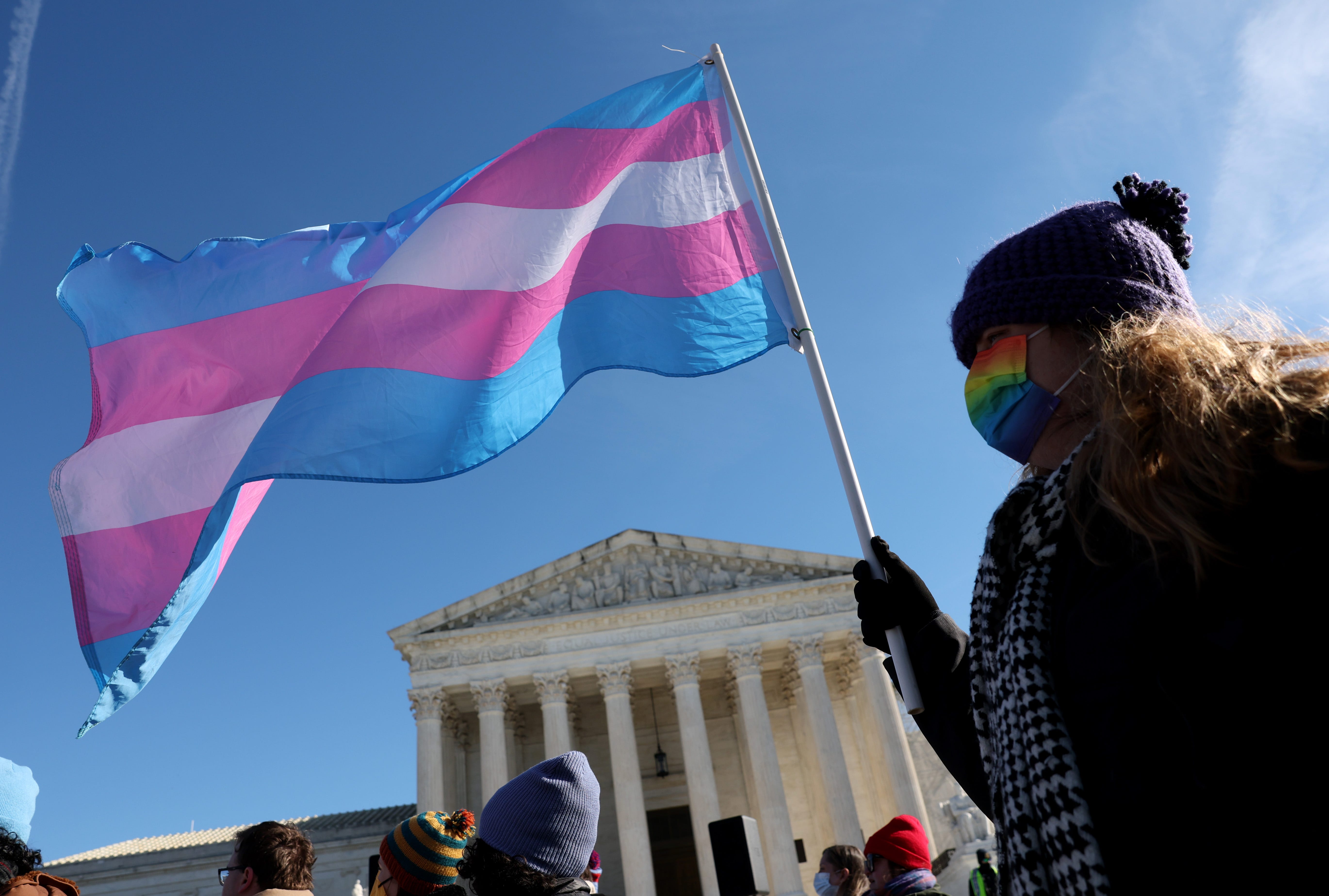
Last week saw yet another victory for women’s rights in the US. The Supreme Court upheld state bans on males participating in girls’ sports. Predictably, the ruling was split along party lines, with the six Republican appointees supporting single-sex sports and the three Democrat appointees voting against.
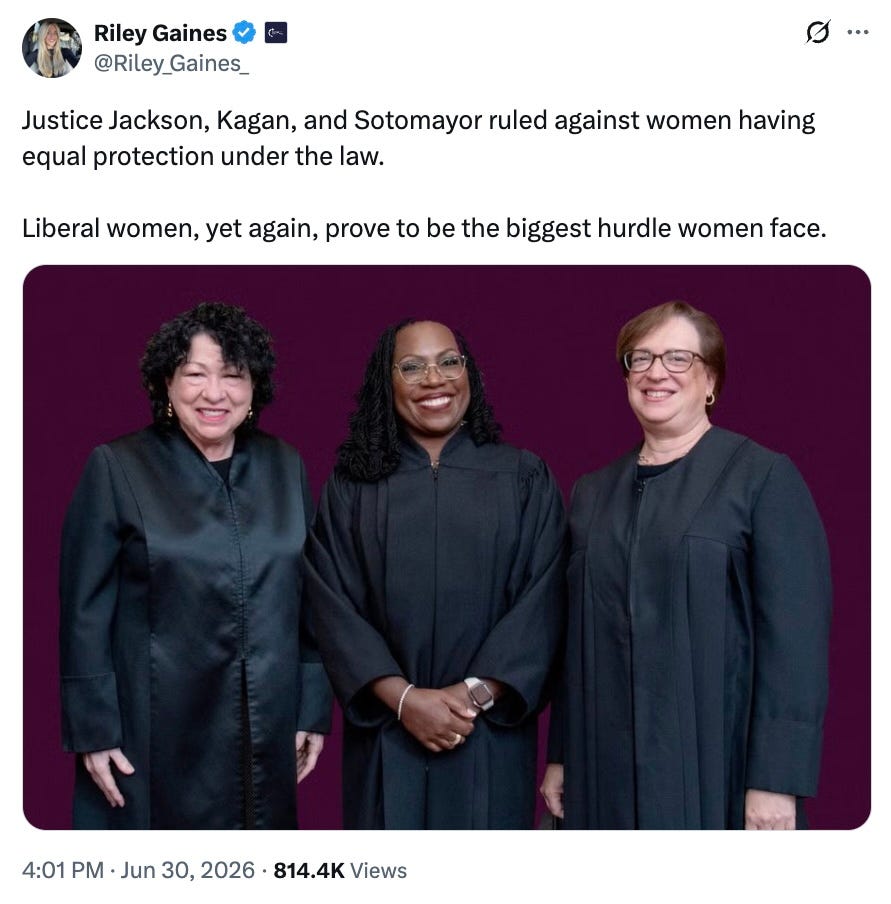
Riley Gaines has been quick to note the perversity of so-called ‘progressives’ working against women. ‘Justice Jackson, Kagan, and Sotomayor ruled against women having equal protection under the law,’ she posted on X. ‘Liberal women, yet again, prove to be the biggest hurdle women face.’
It is a feature of today’s culture wars that so many individuals are gulled into working against their own interests. Time and again, polls reveal that the staunchest advocates for gender identity ideology are women, even though it is a fundamentally anti-woman movement. Likewise, many gay men are found to be supportive of genderism, in spite of the fact that it represents the most serious threat to gay rights in living memory.
So what is going on here? I am reminded of Alice Walker’s novel Possessing the Secret of Joy (1992). The book opens with an arresting epigraph: ‘When the axe came into the forest, the trees said the handle is one of us’. The novel concerns the barbarity of Female Genital Mutilation (FGM) as practised in certain African tribal societies, which is why Walker dedicated the book ‘with tenderness and respect to the blameless vulva’.
We often speak of FGM as though it were an example of the patriarchy destroying women’s sexuality, making it impossible for girls, as they grow up, to experience sexual pleasure so that they will remain faithful to their husbands. While there is some truth to this analysis, Walker forces us to confront a harsher reality. One of the most striking aspects of the novel is the depiction of the older women in the tribe as being mostly responsible for the perpetuation of the practice. Little girls are mutilated at the behest of their mothers, grandmothers, aunts, sisters. Often the men know little at all.
The novel was the inspiration for Tori Amos’s Cornflake Girl, surely the only song about female genital mutilation ever to break the top ten. But Amos’s song is really about that broader principle of betrayal among women. Today, the song resonates for a different reason. The ‘cornflake girls’ – those who turn on other women – are now mostly to be found on the self-styled ‘progressive’ side of politics, upholding an ideology that has seen the erosion of women’s single-sex spaces and services.
The full piece is here:
https://www.andrewdoyle.org/p/why-are-women-and-gay-men-backing
Endpiece
I am going to intervene here.
The piece above about shooting and archery brings to my mind the scene in True Grit (2010) when Marshall Rooster Cogburn, single handedly. takes on the four members of the Ned Pepper gang. Up on the bluff above the plain where the shoot out takes place are Texas Ranger La Boeuf with his rifle and Mattie Ross. It becomes necessary for La Boeuf to try a very long distance shot!
For the cast see here: https://en.wikipedia.org/wiki/True_Grit_(2010_film)
Some bully shot!

#BeMorePorcupine
#KeepTerfing
#MakeOrwellFictionAgain
#KeepFighting
#RepealTheGRA
#AdultHumanFemale
#LetWomenSpeak
#LGB✂️TQ
#BeMoreDissident
#HoldTheLine
#StopTheBlockersTrial
#NeverSurrender
#NeverForget
#TruthWillTriumph
#WeWillWin
I left a short comment on the Andrew Doyle but I’ll expand slightly on that. All humans are tribal. The tribe provides safety and survival, particularly for women. And women especially are brought up to be kind and support the tribe for those reasons. It’s a human instinct. We also have decades of leftie indoctrination to contend with- be kind, you are an evil white colonialist. But in the modern era, I think this is a cop out. We all have free will and the ability to think critically; to weigh up ideas and make decisions based on facts and evidence. It takes bravery to do this and stand against the prevailing tribal opinion. We see this throughout history. The people who’ve righted wrongs in the face of opposition, are brave. So, this will sound harsh, but I think that at the heart of the be kind brigade, is cowardice. They use the cloak of ideology to shield themselves from scrutiny but they are essentially cowards who use the tactics of the bully to protect themselves and their ideology. We often say that if everyone had spoken out years ago, had shown some bravery, children could have been protected from this vile ideology. So for that reason alone, I have no patience with the be kind mob and despise them. Other opinions are available. 😁
#BeMoreDissident
Can I nominate Patton please, Dusty, to be added to your film list - highly recommended.
From wiki:
Patton is a 1970 American epic biographical war film about U.S. General George S. Patton during World War II. It stars George C. Scott as Patton and Karl Malden as General Omar Bradley. The film was directed by Franklin J. Schaffner from a script by Francis Ford Coppola and Edmund H. North, who based their screenplay on Patton: Ordeal and Triumph by Ladislas Farago and Bradley's memoir, A Soldier's Story.
It won seven Academy Awards, including Best Picture, Best Director and Best Original Screenplay. Scott also won the Best Actor for his performance, though he declined the award [apparently he said he didn't believe in competitive acting].
The opening monologue, delivered by Scott as General Patton with an enormous American flag behind him, remains an iconic and often quoted image in film. In 2003, Patton was selected for preservation in the United States National Film Registry by the Library of Congress as being "culturally, historically or aesthetically significant". The Academy Film Archive also preserved Patton in 2003.