
The World Is Watching
Update 934. #BeMorePorcupine.

I am jumping in quickly here with the judgment of the challenge to the puberty blockers clinical trial and I am devastated to inform you that permission to proceed has been refused. I can now reveal that my prediction ( which I had just kept in my head) was that we had lost based on the interjections from the judge during the proceedings with his reference to “distressed children” and the fact that he made far more negative interventions to the arguments presented by Mr McCulloch for the claimants than he did to the other barristers. Obviously, I take no solace in my correct prediction.I wish I had been wrong!!
Below we have the press release from the solicitors for the claimants, Conrathe Gardner and from Bayswater Support Group plus the summary from the court itself. The judgment is here:
https://www.judiciary.uk/wp-content/uploads/2026/07/Bayswater-Approved-Judgment.pdf
The Conrathe Gardner press release starts with “The world is watching.” This is not hyperbole. If this trial proceeds over a mere two year period it is set up to succeed. Everyone knows that regrets and medical complications take longer than two years to become apparent. The questionnaire designed for the children is ridiculously simplistic. If the trial results in a thumbs up for puberty blockers this could collapse a lot if not all of the bans on puberty blockers around the world.
Looking at this from a wider angle, it increasingly seems to me that the inclusion in the Diagnostic and Statistical Manual of Mental Disorders (DSM) of what is now described as ‘gender incongruence’ is central to the problem. Is this really a ‘disorder’ or just a symptom? If it is a symptom, then you do not treat a symptom, you find the cause. I will return to this issue in a one off as soon as I can.
We wait to see if the claimants will seek to appeal. I do hope they do but this now becomes increasingly difficult for them.
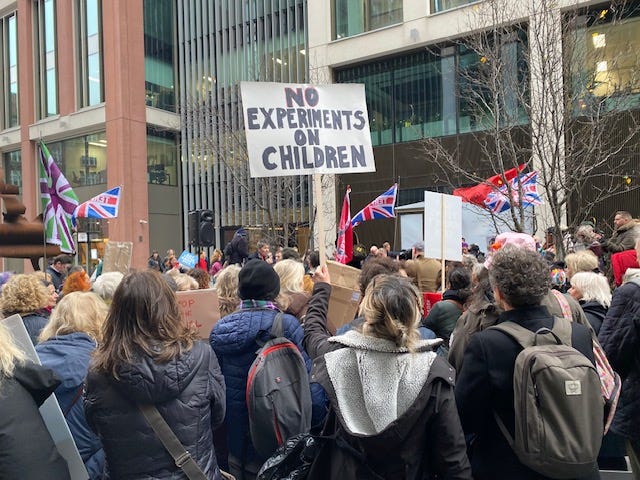
Protest outside the Department of Health, London © Dusty Masterson
Here is the press release from Conrathe Gardner:
Permission refused for Judicial Review challenge of puberty blocker trial
Judge denies opportunity for a full hearing
Claimants James Esses, Bayswater Support Group and Keira Bell are disappointed that Mr Justice Chamberlain has declined to give permission for the judicial review of the PATHWAYS puberty blocker trial.
The world is watching. This case has global implications and the stakes are high. It raises issues of a very serious nature regarding the respecting of statutory safeguards for clinical trials of experimental treatments involving children, safeguards which were especially important in this landmark test case given the known risks of lifelong harms caused by puberty blockers. The claimants have explained to the Court the many respects in which the UK’s medical regulators have failed to comply with the statutory safeguards designed to protect vulnerable children in a clinical trial. The claimants respect the Court’s decision but fundamentally disagree with its conclusions. The judgment proceeds on the basis that questions about the safety, ethics and scientific design of the PATHWAYS trial are matters primarily for specialist regulators and that the Court should be slow to interfere with their assessment. In the claimants’ view, however, this case was not about disagreement with the regulators’ scientific judgments. It concerned whether the statutory safeguards enacted by Parliament for clinical trials involving children were properly applied, and whether regulators could lawfully approve a trial when they accepted that the benefits of treatment for individual participants remained uncertain and there were serious known risks of harm. The claimants remain concerned that these central issues have not been adequately resolved. The judgment also highlights the importance of the wider issues raised by these proceedings. The Court accepted that the case concerned matters of significant public interest and unprecedented scrutiny, but concluded that none of the grounds of challenge met the threshold for permission. The claimants continue to believe that important questions remain unanswered, including the extent to which regulators must ensure that children enrolled in clinical trials of risky experimental treatments are likely to derive direct benefit from participation, and whether the regulatory framework governing research involving minors has been interpreted consistently with the protections it was designed to provide. For that reason, they are carefully considering the judgment and the possibility of seeking permission to appeal.
The case is particularly important because the UK has recently implemented reform of clinical trial regulation through amendments to the Medicines for Human Use (Clinical Trials) Regulations. The core purpose was to strengthen participant protection and improve safety oversight. The claimants are therefore disappointed that the High Court has decided not to give permission for this legal challenge to proceed. Given the seriousness of these issues, the claimants will give careful consideration to appealing this High Court decision.
James Esses, psychotherapist and claimant, said, ‘‘I’m deeply disappointed that we’ve been denied the opportunity to take this case to a full hearing in our pursuit to halt the deeply unethical and highly dangerous puberty blockers trial. This judgment does not negate the serious and avoidable harm that will be caused if this trial is allowed to proceed. Vulnerable children should never be used as guinea pigs in medical experimentation that may lead them down a path towards irreversible physiological and emotional damage, including infertility. This trial is the antithesis of child safeguarding and I will now be consulting with my lawyers regarding the possibility of an appeal.”
A spokesperson for Bayswater Support Group, claimant, said, “Bayswater Support Group is extremely disappointed that the High Court has refused permission for our judicial review of the PATHWAYS trial approvals. We brought this challenge because we believe the decision to authorise a clinical trial of puberty blockers in children failed to meet the protective requirements that exist specifically for research involving minors. The Medicines for Human Use (Clinical Trials) Regulations and the principles of the Declaration of Helsinki are supposed to ensure that children, who cannot consent for themselves, are only enrolled in trials that offer a realistic prospect of direct benefit and rest on a proper scientific foundation. They are not intended to permit experimental interventions on highly vulnerable children simply in order to discover whether benefit exists. We remain of the view that the PATHWAYS trial does not meet the legal and ethical thresholds required for research on children. Bayswater Support Group will continue to support families, to press for genuine evidence-based care, and to insist that the safeguarding of children must come first. We intend to explore with our legal team every remaining avenue to uphold the protections that exist for the most vulnerable participants in medical research.”
Keira Bell, the third claimant, said, “It is a tragedy that the court has refused permission for this challenge to proceed. The medical profession and morality do not always walk hand-in-hand. If they did, this trial would be out of the question. The push for this trial represents one aspect of a profound descent into the desecration of our humanity. The protection of children should be an inviolate principle, but this clinical trial tells a different story. I know first-hand how much this process breaks you. My story and the story of many others since should have been a big enough warning. A trial has already been conducted and the results were bleak. The bottom line is that responsible adults must protect children from harm. We will be consulting as a team regarding the possibility of appeal.”
Stephanie Davies-Arai, of Transgender Trend, said, “We are disappointed that the judge has refused permission for a full judicial review of the controversial puberty blocker trial. In our view the trial as proposed is unethical, experimental and unsafe. Children as young as 11 will have their critical growth at puberty stopped for two years, introducing medical harm to previously healthy bodies. The trial will go ahead despite leaving many questions unanswered and public confidence in the medical profession shattered. This is an unprecedented experiment on children who are too young to be able to give full consent. When the risks are serious and profoundly life-changing and the benefits uncertain it is unethical to experiment on children. The trial as proposed is unlikely in any case to provide answers to the question of benefit and risk. The results of the trial in its current design would almost certainly have been rejected by the Cass Review as low-quality evidence. This trial introduces a new low safety bar and sets a worrying precedent for the protection of children in future medical trials. If this trial is considered compatible with international standards, any medical trial with equally low safety standards can be justified. The key evidence presented on behalf of the claimants at the permission hearing was that the trial as currently proposed does not meet the condition of clinical trials for minors in international regulations. The evidence presented by the defendants ran to 13,000 documents but still provided no answer to this fundamental objection. This is a medical approach with no precedent. The Department of Health and Social Care (DHSC) along with all the experts at Kings College London (KCL), the Maudsley hospital (SLaM), the Health Research Authority (HRA) and Medicines and Healthcare Regulatory Agency (MHRA) could provide no evidence that blockers are likely to produce benefits for the trial participants. We are dismayed that the UK can ignore international medical trial guidelines and proceed with a trial that does not meet the conditions for medical trials on minors. Protection of children should come first.”
Louise Irvine, a retired GP and Chair of the CAN-SG, said, “The Clinical Advisory Network on Sex and Gender is extremely disappointed in today's decision not to permit judicial review of the Pathways puberty blocker trial. CAN-SG repeatedly highlighted to the regulators our grave concerns about the ethics and scientific merit of the trial. Clinical trial regulations demand that in research involving human subjects the potential benefits must outweigh the risks. We believe Pathways falls at the first hurdle: the potential benefits do not outweigh the risks. Many risks are very serious and have been minimised or disregarded by both by the trial sponsors and the regulators. We believe the regulators have failed in their primary duty of protecting children from harm and we are extremely disappointed that the risks to children's health from this trial will now not be subjected to scrutiny in a judicial review.”
Caroline Farrow, of CitizenGo, said, “This is a bitterly disappointing decision, but it does not make the profound ethical and safeguarding concerns surrounding this trial disappear. Puberty is a healthy and natural process, not a disease, and it is extraordinary that children may now be exposed to drugs which disrupt it when there is still no reliable evidence that doing so will benefit them. We will continue to speak out for the children placed at risk.”
ENDS
Here is the separate press release from the Bayswater Support Group:
“The damage to trust this causes is particularly serious because of what has already occurred. Many parents lived through the failures of the former GIDS service and its early intervention research, where children were placed on puberty blockers on a weak evidence
base, with inadequate follow-up and outcomes that fell far short of what parents were led to expect.
To date, nobody has been held accountable for these failures. As a result, Bayswater families already lack confidence that the NHS will objectively support their child and regularly self exclude from services their children need.
The court’s refusal to examine whether the special legal and ethical safeguards for research on children were properly applied, only reinforces that existing lack of trust in the regulatory safeguards for children in the NHS.”
“We remain of the view that the PATHWAYS trial does not meet the legal and ethical thresholds required for research on children. The design and scale of the study, the known and potential harms of the intervention, and the absence of a sufficient prior evidence
base of benefit raise fundamental questions about whether the protective framework for minors has been properly implemented.”
MORE INFORMATION
press@bayswatersupport.org.uk
+44 7866 234 319
BACKGROUND
We brought this challenge because we believe the decision to authorise a clinical trial of puberty blockers in children failed to meet the protective requirements that exist specifically for research involving minors.
The Medicines for Human Use (Clinical Trials) Regulations and the principles of the Declaration of Helsinki are supposed to ensure that children, who cannot consent for themselves, are only enrolled in trials that offer a realistic prospect of direct benefit and rest on a proper scientific foundation.
They are not intended to permit experimental interventions on highly vulnerable children simply in order to discover whether “potential” benefit exists. The protective framework requires that a sufficient prospect of direct benefit already be clearly established
before children who cannot consent for themselves are enrolled.
The refusal of permission means these arguments will now not be fully tested in court.
ABOUT US
Bayswater Support Group will continue to:
- support the hundreds of families who come to
us
- press for genuine evidence-based care
- insist that the safeguarding of children must
come first.
THANK YOU
We wish to thank our legal team from Conrathe Gardner and our funders CitizenGO. We intend to explore with them every remaining avenue to uphold the protections that exist for the most vulnerable participants in medical research.
Here is the summary from the Court:
This summary is provided by the Court for the assistance of those reporting the judgment (neutral citation [2026] EWHC 2043 (Admin)). It does not form part of that judgment. Headline 1 Mr Justice Chamberlain has today rejected a challenge to regulatory decisions in relation to the PATHWAYS clinical trial for puberty suppressing hormones (“PSH”). Background
2 In 2020, NHS England commissioned the paediatrician Dr Hilary Cass (now Baroness Cass) to chair a review of gender identity services for children and young people. A central finding of what became known as the Cass Review was that the evidence base for the use of PSH in children and young people with gender incongruence was very weak.
3 NHS England and the Secretary of State commissioned a clinical trial designed to address the “evidence gap” identified by the Cass Review: the Puberty Suppression and Transitional Healthcare with Adaptive Youth Service or “PATHWAYS Trial”. The Trial was co-sponsored by King’s College London and the South London and Maudsley NHS Foundation Trust. They are interested parties in this case.
4 The sponsors submitted an application for regulatory approval in August 2025. Approval was given in November 2025 by the Medicines and Health Regulatory Agency (“MHRA”) on behalf of the Secretary of State and by the Health Research Authority (“HRA”). The Secretary of State and the HRA are the defendants in this case.
5 There were then two developments. A group of clinicians wrote to the regulatory authorities to express their concerns and the Secretary of State for Health and Social Care announced a pause on new prescriptions for masculinising and feminising (“MAF”) hormones for young people.
6 The MHRA asked further questions of the co-sponsors with a view to considering whether to maintain the approvals. The co-sponsors made an application to modify the Trial protocol. That application was approved by the MHRA and the HRA in June 2026.
The claimants
7 The first claimant, Bayswater Support Group, represents and provides advice and support to about 800 parents and guardians of children and young adults who identify as trans or nonbinary. It has members in all regions of the United Kingdom, as well as in the Republic of Ireland.
8 The second claimant, Keira Bell, has personal experience of treatment for gender dysphoria and is a long-standing campaigner on issues relating to such treatment. She has brought litigation in the public interest before.
9 The third claimant, James Esses, is a practising psychotherapist and founder of the organisation Thoughtful Therapists and Just Therapy. He is an advocate for evidence based treatment for gender dysphoria.
The claim
10 The claimants initially challenged the November 2025 decisions of the MHRA and HRA on five grounds. With the permission of the court, they amended their claim to add a challenge to the June 2026 decisions. They also made an application for an interim order to stop the Trial from going ahead while the case was considered.
Procedure
11 In judicial review, claimants require the permission of the court to proceed to a substantive hearing. In this case, the Court ordered that the application for permission to apply for judicial review should be considered at a hearing together with the application for an interim order.
12 The hearing took two full days on 27 and 28 July 2026. In advance, the parties filed including 31 witness statements, detailed written submissions and authorities. The documentation ran to over 13,000 pages.
Decision
13 The applications for permission to apply for judicial review and for an interim order were both refused.
Summary of reasons
14 The judge’s reasons can be summarised as follows:
(a) The Trial was commissioned by NHS England and designed by its co-sponsors with conspicuous care, in consultation with other expert bodies. The participants will be children with persistent gender incongruence who are receiving treatment from specialist gender services. Each child will have been assessed over many months by specialist doctors. In each case, the treating team will have formed the opinion that the child has a reasonable prospect of receiving a clinical benefit from the treatment. There is a detailed process to ensure that the child assents and a parent consents to the treatment, having been fully informed of what it involves and of its potential outcomes. A second opinion will be obtained from a National Multi-Disciplinary Team (“NMDT”) of paediatric and other specialists to ensure that participation is clinically appropriate in the individual case.
(b) UK law requires clinical trials to be approved by two specialist bodies. The MHRA is responsible for the safety of the clinical trial and the safeguarding of participants. It undertook a rigorous process to assess the trial before giving its initial approval in November 2025. It later took on board concerns raised by a group of sceptical clinicians and considered the impact of an intervening decision by NHS England to pause prescriptions of MAF hormones for young people. It asked a series of questions of the trial co-sponsors before concluding in June 2026 that the Trial could proceed with a modified protocol. The HRA was required to and did refer the question of ethical approval to a Research Ethics Committee (“REC”) including both paediatric consultants and lay people. The REC gave that approval in November and, having reconsidered the position in the light of subsequent developments, affirmed its approval of the modified protocol in June 2026.
(c) Where regulatory functions have been conferred on a specialist regulator with technical or scientific expertise, it will generally be because the function is best performed by persons who have been trained in the scientific method. In assessing an application for approval in a context such as this, the specialist regulator can use its prior experience to spot gaps, ask probing questions and evaluate the responses. If the regulator’s decision is challenged on rationality grounds in judicial review proceedings, the court must be very cautious about interfering with that decision. The Court’s function is not to say whether it agrees with the decision under challenge, but rather to examine whether the defendants have exercised their functions contrary to the legislative scheme or otherwise unlawfully. These principles apply to both regulators whose decisions are challenged here.
(d) The claimants advanced their challenge to the HRA’s and MHRA’s November 2025 and June 2026 decisions under five grounds. After careful examination, none of them is arguable with a realistic prospect of success:
(i) In its June 2026 decision, the MHRA properly recognised that the likelihood that trial participants would have access to PSH and/or MAF hormones after their participation in the trial came to an end (“the destination therapy issue”) was critical to its decision. Its conclusion, taking account of that issue, was rational. The MHRA rationally concluded that “[s]ome direct benefit for the group of patients involved in the clinical trial is to be obtained from that trial”. The HRA’s research ethics committee (“REC”) did not fail to take account any of the relevant matters identified by the claimants.
(ii) The HRA was not required by the regulatory regime to place third-party comments before the REC. Its decision not to do so in the lead-up to the November 2025 decision has been fully explained and was rational. Its decision as to which of the third-party comments to place before the REC before the June 2026 decision was also rational.
(iii) By the end of the hearing, only one of the claimants’ six complaints about the HRA’s processes advanced under ground 3 was maintained—lack of transparency. In relation to the November 2025 decision, the REC published an adequate summary of the research it had reviewed. Although it did not publish a summary of the reasons for its opinion, the claimants now know the reasons and, as a result of this judgment, so does the public. In those circumstances, no useful purpose would be served by the grant of permission. In relation to the June 2026 decision, the decision was only taken six weeks ago and the law does not set a deadline for publication.
(iv) None of the claimants’ irrationality complaints is well-founded. The design and purpose of the Trial were fully explained in the application materials. The suggestion that the Trial lacked a valid testable hypothesis is based on a misunderstanding of its purpose: it was a pragmatic trial designed to assess the benefits and risks of PSH. Whether to approve a trial with this purpose was quintessentially a question of judgment for the MHRA and HRA.
(v) The regulatory regime imposes a duty on the MHRA to give reasons in some circumstances, but not when it approves a clinical trial or the modification of a trial protocol. There are no particularly strong policy reasons to impose a common law duty. In any event, there would be no point in granting permission on this ground given that the claimants now have a vast amount of material explaining the MHRA’s and HRA’s reasons for the approvals and, by virtue of the publication this judgment, so does the public at large.
(e) Because none of the grounds of challenge has a realistic prospect of success, the question of interim relief pending a substantive hearing does not arise. Even if permission had been granted on one or more of the grounds which could lead to the quashing of the authorisations, interim relief would nevertheless have been refused. The harm that would be done to the public interest and the interests of Trial participants in the scenario where interim relief is granted but the claim later fails firmly outweighs any harm that might accrue to Trial participants in the scenario where interim relief is refused but the claim later succeeds.
Ends
I am grateful to James Esses and Eileen Gardner of Conrathe Gardner for their assistance.
All thoughts gratefully received.

#BeMorePorcupine
#StopTheClinicalTrial
I am sickened and heartbroken at this decision.
Terrible news. I really can't grasp the details of the reasoning for the refusal; I don't understand enough of what's going on. Dusty, do you have any idea if there's grounds for appeal. You should probably get some rest.