
No More Excuses!
Update 878. New Guidance Special. #BeMore Porcupine.

I am just jumping in with a short update here given this important development. I am deferring the film series and endpieces until the next update.
Since the Supreme Court judgment in the For Women Scotland case, government departments and major organisations have been using the (rubbish) excuse that they are awaiting the guidance from the Equality and Human Rights Commission (EHRC). Well now that guidance is out and there are no more excuses. BTW we all want to get rid of the protected characteristic of ‘gender reassignment’ but we are stuck with it for the time being.

We cover here commentary on the guidance. Maya Forstater gives it 8 out of 10 so it is clearly sufficient to move forward with. In terms of challenging someone as to their sex it is a bit waffly but, ultimately, concludes you can do this. In terms of keeping data, it also gets a bit confused ( it incorrectly states that ‘sex’ is ‘special category data’) but, once again, concludes that you can collect someone’s data with regard to sex.
Sex Matters provide a useful video discussing this:
And they provide a very useful substack which I am quoting the whole of since it is not behind a paywall:
What is in the new guidance?
May 21, 2026
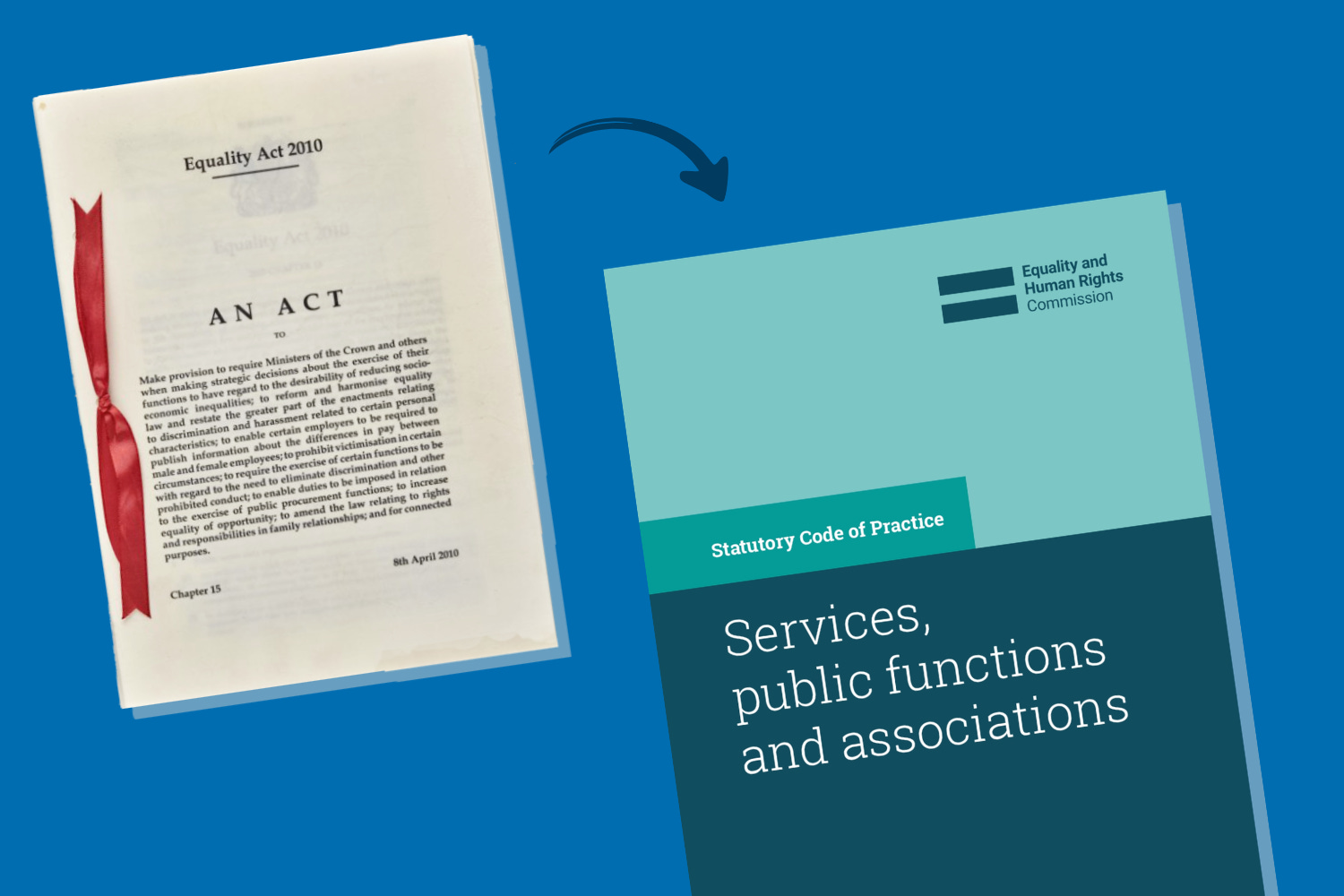
The Equality and Human Rights Commission’s updated Code of practice for services, public functions and associations has finally been agreed by the Minister for Women and Equalities and laid before Parliament. A statutory instrument laid under the “negative procedure” becomes law on the day the minister signs it and automatically remains law unless a motion – or “prayer” – to reject it is agreed by either the House of Commons or the House of Lords within a specified period (in this case, the usual 40 days).
Nothing in the code of practice changes the Equality Act 2010. What it does is provide detailed, practical guidance on how to interpret the act. It also removes the excuse of “waiting for guidance”.
Thanks for reading Sex Matters News! Subscribe for free to get new posts.
Duty bearers that have been using this excuse for inaction, or telling themselves that their policies based on gender self-ID “remain lawful”, are acting irresponsibly and taking significant risk.
The previous version, published in 2011, was ambiguous about the relationship between the protected characteristics of sex and gender. It said:
“If a service provider provides single- or separate sex services for women and men, or provides services differently to women and men, they should treat transsexual people according to the gender role in which they present.”
It told service providers to operate based on gender self-ID and that they could exclude transgender individuals from services provided for members of the opposite sex only on a “case-by-case” basis. This ignored other people’s rights, was unworkable for service providers and, as the Supreme Court made clear in 2025, was wrong in law.
The new code of practice has removed that error and provided much more detail on the single-sex and separate-sex exceptions in order to counter confusion and misinformation
The new guidance says clearly (emphasis added):
13.130 If a service provider (or a person providing a service in the exercise of public functions) admits trans people to a service intended for the opposite sex, then it can no longer rely on the [single and separate sex exceptions]. This means that if a service is provided only to women and trans women or only to men and trans men, it is not a separate-sex or single-sex service under the Equality Act 2010.
13.131 A service like this is very likely to amount to unlawful sex discrimination against the people of the opposite sex who are not allowed to use it. A service which is provided to women and trans women could also be unlawful sex discrimination or lead to unlawful harassment against women who use the service. Similar considerations would apply to a service provided for men and trans men.
It is possible to offer a mixed-sex service alongside a single-sex service. A mixed-sex service must be open to all service users.
There is a lot of detail in chapter 13 on the exceptions. But in most situations providing a single-sex or separate-sex service is going to be simple and straightforward, as the EHRC has already said in its interim update.
In order to understand the exceptions in the Equality Act, duty bearers need to understand how the act works. The code of practice explains this.
The protected characteristics
The guidance begins by defining the nine protected characteristics, including sex and gender reassignment.
“Sex” means being male or female. The comparator in a sex-discrimination claim is someone of the opposite sex.
“Gender reassignment” is a broad characteristic which covers someone who is at any stage of a personal transition journey, defined as “proposing to undergo, undergoing, or having undergone a process to reassign sex”. It is a protected characteristic separate from sex or sexual orientation. Having this characteristic does not change a person’s sex.
A trans person is protected from sex discrimination based on their sex at birth, and also from sex discrimination related to their “acquired gender” (for example through association or perceived sex).
Unlawful acts
The guidance then explains the familiar Equality Act framework of unlawful acts:
Direct discrimination: occurs when a person is treated less favourably because of a protected characteristic. It is generally unlawful, unless an express exception can be relied on. This means that providing a single-sex or separate-sex service is likely to be unlawful direct discrimination, unless one of the exceptions in the Equality Act applies.
Indirect discrimination: occurs when an apparently neutral provision, criterion, or practice puts people sharing a protected characteristic at a particular disadvantage. It is not unlawful if it is a “proportionate means of achieving a legitimate aim”.
The aim must be legal, non-discriminatory, and a “real, objective consideration” (for example, ensuring health and safety, wellbeing or dignity). Reducing costs alone is not a sufficient aim.
The means must be proportionate, meaning the disadvantages caused must not be disproportionate to the aims pursued.
Harassment: involves unwanted conduct related to a protected characteristic (including age, disability, gender reassignment, race and sex) that violates an individual’s dignity or creates an intimidating, hostile, degrading, humiliating, or offensive environment.
The effect of the conduct is sufficient to establish unlawful harassment, regardless of intent.
In deciding if conduct is harassment, courts consider the individual’s perception, circumstances and whether the effect is objectively reasonable (that is, not based on hypersensitivity).
The other person’s right to freedom of thought, religion and speech must also be considered.
Victimisation: subjecting a person to detriment because they have done a “protected act”, such as bringing proceedings under the act or making an allegation of a breach.
Duty bearers
The code of practice relates to the part of that act that covers providers of services (such as local authorities, hospitals and shops), those exercising public functions (such as law enforcement and licensing) and associations (with 25 or more members and regulated admission).
Exceptions
The new code of practice includes detailed guidance on the Equality Act’s exceptions, which permit otherwise unlawful discrimination.
Positive action: it is lawful for service providers and public authorities to to take proportionate action to overcome or minimise disadvantages, meet different needs, or encourage participation for people who share a protected characteristic.
Charities: it is lawful for charities to provide benefits exclusively to people sharing a protected characteristic if it is a proportionate means to a legitimate aim, or for the purpose of preventing or compensating for a disadvantage.
Competitive sport: it is lawful to organise single-sex or separate-sex events where an average person of one sex would be at a disadvantage due to physical strength, stamina or physique.
Sex-based rules should be applied on the basis of biological sex:
13.69 Arrangements relating to participation in a gender-affected activity which do not enable fair and safe competition between men and women may amount to unlawful sex discrimination against competitors of either sex, if they are placed at a disadvantage because of those arrangements.
…
13.73 Any sex-based rules or arrangements relating to participation in a gender-affected activity (read paragraph 13.65) should be applied on the basis of biological sex. Therefore, trans people should not be included in single-sex or separate-sex competitions for the sex with which they identify….
Trans people can be excluded or treated differently from members of their own sex if necessary for fair competition or safety. Organisers should consider alternative arrangements, such as mixed-sex categories, to enable trans people to participate.
Separate services for women and men: it is lawful to provide separate services or facilities for women and men if a joint service would be less effective and providing the service separately is a proportionate means of achieving a legitimate aim.
Single-sex services: it is lawful to provide a service exclusively to one sex if it is a proportionate means of achieving a legitimate aim and one of six conditions applies (for example, that only one sex needs the service; that a woman might reasonably object to the presence of a man due to undressing or being in a vulnerable situation; or that physical contact is involved).
Proportionality considerations: a legitimate aim for single-sex provision includes ensuring the safety, privacy and dignity of women, men or both.
The service provider must balance the benefits of the single-sex service (such as reduced risk to women in contexts of undress or male violence) against the needs of all potential users and the impact on those excluded, including trans people.
If a service provider allows trans people to use a service intended for the opposite sex, it is no longer a single-sex service under the act and is very likely to be unlawful sex discrimination against others.
If a single-sex service is justified, preventing, limiting or modifying a trans person’s access to the service for their own sex is lawful only if it is a proportionate means of achieving a legitimate aim, such as preventing discomfort or distress for other service users. “Service providers should consider whether other service users could reasonably object because they are worried about sharing a single or separate-sex service with someone who appears to be of the opposite sex.” (13.147)
Communal accommodation: exclusion based on sex or on gender reassignment is lawful only if it is a proportionate means of achieving a legitimate aim and the accommodation is managed in a way that is as fair as possible to both men and women.
Importantly, the EHRC explicitly states that if a women-only service admits “trans women” (trans-identifying men), it may cease to qualify legally as a single-sex service under the Equality Act. That is a major clarification. For years, many organisations assumed they could remain “women-only” while also operating on the basis of gender identity. The guidance says that this will undermine reliance on the act’s single-sex exceptions (see paragraph 13.130 above).
Considering women’s needs
The guidance explicitly recognises that women may reasonably object to the presence of males in contexts involving undressing, trauma recovery or intimate services. The guidance treats those concerns as legitimate factors in the proportionality assessment about whether to provide a single-sex service.
13.107 …It is likely to be reasonable for a woman to object to the presence of a man if she will be getting undressed or in a vulnerable situation when she is using the service.
It makes clear that if a service provider decides to provide a service only on a mixed-sex basis, in situations where women are likely to be in a state of undress; where there will be limited ability to leave or to choose an alternative service; where the service is provided a result of or connected with male violence against women; or where the physical differences between men and women are relevant to the experience of the service and put women at a particular disadvantage, this could be direct or indirect sex discrimination against women who use the service or lead to unlawful harassment against them.
Considering trans people’s needs
The guidance makes clear that it would be direct gender-reassignment discrimination to restrict access by trans people to services provided to people of their birth sex or people of both sexes. However, in relation to single-sex and separate-sex services and sports, this may be lawful.
For universally necessary services like toilets, it is very unlikely to be proportionate to leave a trans person with no service they are allowed to use.
Service providers are encouraged to consider alternative arrangements, mixed services or additional provision where possible. They are also expected to treat people sensitively and avoid unnecessary humiliation.
Asking about sex
There is a new section concerning asking users about their sex. This section is overcomplicated and contradictory. Although it says that service providers can ask and record what sex people are, it suggests that this is an extraordinarily difficult thing to do, rather than a simple matter of observing or recording ordinary personal data in a routine way.
Service providers can ask an individual about their sex where this is a proportionate means of achieving a legitimate aim (such as diversity monitoring, operational reasons or lawful single-sex provision).
In single-sex services, the primary method for establishing lawful provision is clear communication (such as “signage, promotional materials including online and hard copies and verbal information provided as part of any enrolment, admission or induction process”; 13.167).
Asking an individual to confirm their sex may be legitimate where there is clear evidence (based on physique or behaviour, for example) of the opposite sex accessing the service or because other people have complained.
Although the code prevaricates and expresses caution about asking a person what sex they are, it concludes that a service provider can ask, and can exclude someone of the wrong sex (13.178).
The guidance notes that no official UK document reliably proves biological sex, since documents like passports and driving licences can be changed.
Section 13.182 says:
“Information about sex is likely to constitute special category data for the purposes of the Data Protection Act 2018 (DPA) and UK General Data Protection Regulations (GDPR). Processing personal data should be done with regard to that legislation and the constraints of the relevant systems and resources.”
This is wrong in law.
Article 9(1) of UK GDPR defines special category data as “personal data revealing racial or ethnic origin, political opinions, religious or philosophical beliefs, or trade union membership, and the processing of genetic data, biometric data for the purpose of uniquely identifying a natural person, data concerning health or data concerning a natural person’s sex life or sexual orientation shall be prohibited.” It does not include sex.
https://www.sex-matters-news.org/p/what-is-in-the-new-guidance
The Daily Sceptic runs with a piece by Will Jones suggesting that larping men ( or women) should not be questioned about their sex if they are using an opposite sex facility. This is incorrect ( see the Sex Matters report).
Transgender ‘Women’ Should Not Be Asked What Sex They Are in Toilets, Guidance From Equalities Watchdog States
22 May 2026

Transgender ‘women’ should not be asked what sex they are when using toilets in public, according to new rules from Britain’s equalities watchdog the Equality and Human Rights Commission, and doing so could be “discrimination or harassment”. The Mail has the story.
Delayed guidance by the equalities watchdog says it is “unlikely to be either practical or appropriate” to challenge people if they should be using the gents’ or the ladies’ in places such as supermarkets or cinemas.
It says signs and websites should be used to tell people that a service is single-sex, and that people can be asked if they are eligible to use it if there is “clear evidence” that men are trying to access female-only areas.
But the Equality and Human Rights Commission’s new Code of Practice, updated in the wake of the landmark Supreme Court ruling on single-sex spaces, warns it is “not always possible to be sure of a person’s sex from their appearance” and no official documents such as passports or driving licences provide “reliable evidence”.
And it states: “It is unlikely to be either practical or appropriate to approach any particular individual to make enquiries about their sex in relation to facilities, such as toilets, which are incidental to the primary service.”
Maya Forstater, Chief Executive of women’s rights charity Sex Matters, welcomed the publication of the document but added: “The guidance could be clearer that service providers are entitled to ask people to state their sex, and to require an honest answer.
“It’s absurd to say that it is ‘unlikely to be either practical or appropriate’ to ask an individual what sex they are in relation to facilities such as toilets: on the contrary, if a man walks into a women’s space it will be not just appropriate to challenge him, but essential. Otherwise women’s rights to single-sex spaces cannot be enforced.”
Equalities Minister Bridget Phillipson, who finally published the 342-page document after being accused of sitting on it for months, said: “The Equality Act enshrines our rights in law so that people can live free from discrimination and harassment.
“Our focus has always been making sure organisations have clear, accessible guidance on how to implement the law.
“I thank the EHRC for its work updating the draft Code of Practice, and look forward to continuing to work with it to ensure people’s rights are upheld across our country.”
The code further says that if “individuals are asked about their sex in a way that requires them to disclose this information in public, or if the language or manner of a request is rude, combative or offensive”, this could be deemed as “discrimination or harassment”.
Andrew Doyle on his substack looks at the predictable meltdown by the ‘trans righta activist.’
The tantrum over single-sex spaces
The furious reaction to the EHRC’s guidance reveals a movement unable to accept legal and biological reality.
May 22, 2026
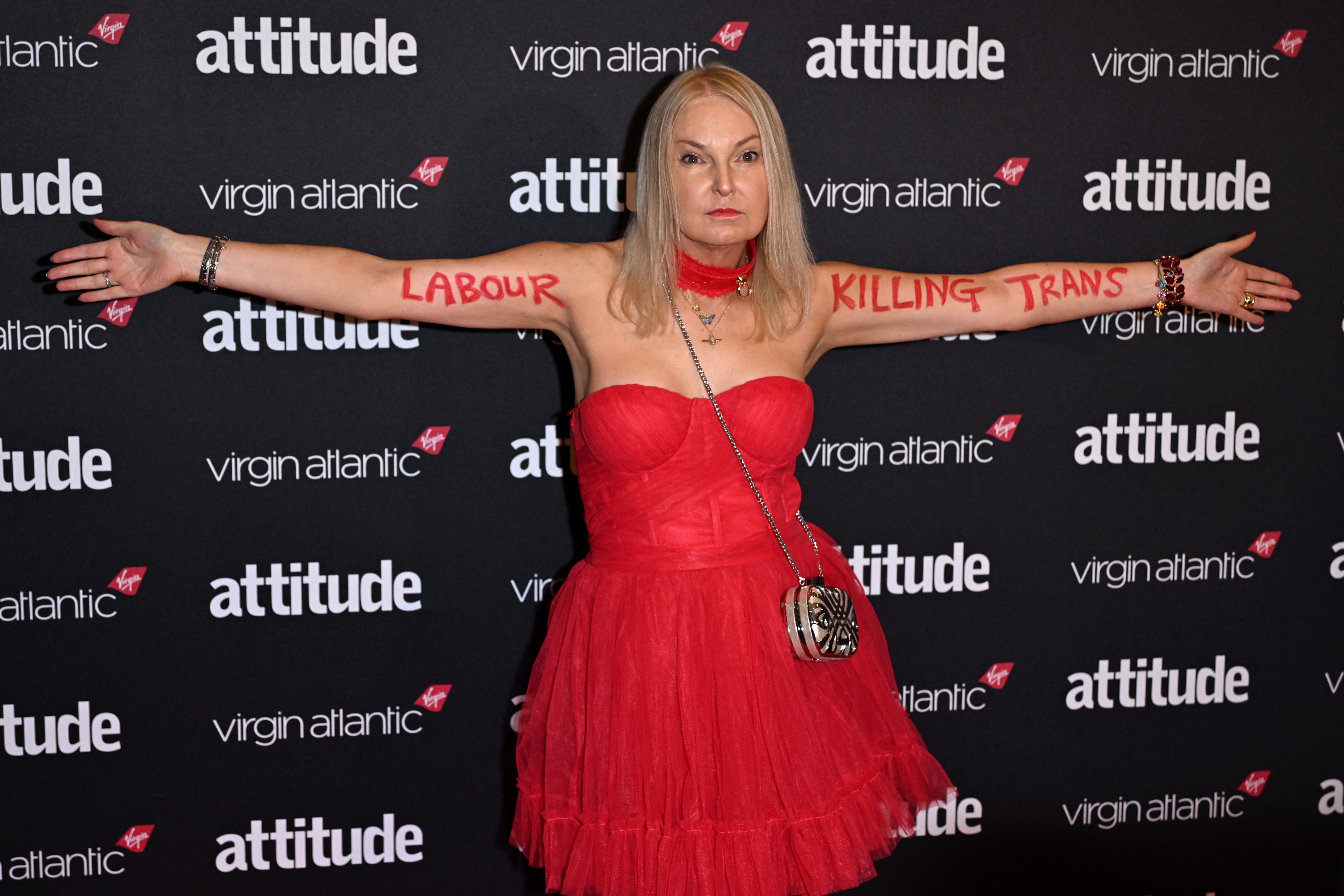
Schadenfreude is the most ignoble of instincts. The English are so ashamed of it that they have left it to the Germans to invent the term. It is of course a perfectly natural impulse, albeit one that we should strive to curb. But who doesn’t feel that warm interior glow when our enemies finally get their comeuppance?
If we’re honest, plenty of us are feeling this way following the publication this week of guidance by the Equalities and Human Rights Commission (EHRC) on single-sex spaces. The meltdowns from those who have consistently attempted to obliterate women’s rights have been predictably melodramatic. The collision with reality has left them smarting, and justifiably so.
‘In a world’s first,’ wrote one activist on X, ‘the United Kingdom moves to make it illegal for trans women to pee. Welcome to 2026 where laws discriminating against and segregating minorities are now commonplace again.’ We have grown accustomed to the trans lobby indulging in fantasies of their own oppression, but the extent of the hysteria is still difficult to fathom coming from grown adults.

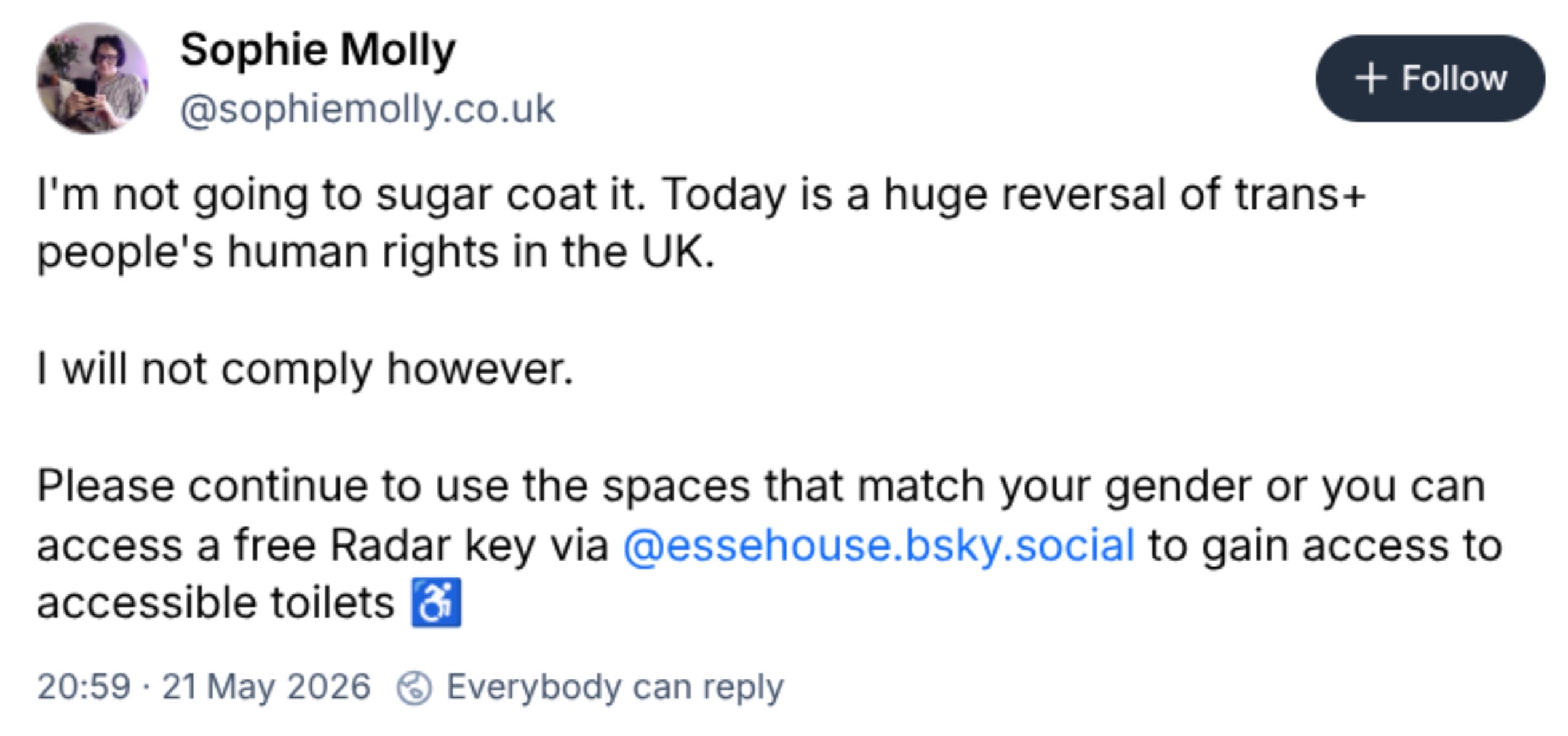

Over on Bluesky, that toxic haven for bigots and bedlamites, the wailing has been deafening. The violent activist group Bash Back has vowed ‘further mass resistance’. Professional troll India Willoughby has called it ‘trans apartheid’ and asserted that he intends to continue breaking the law. Others have compared it to the era of Jim Crow, or taken it as further evidence of ‘trans genocide’.
The infantilism of activist culture has prevented many from calmly accepting the law. Trans-identified people have precisely the same rights as everyone else, and nothing about this guidance has changed that. We need to ask serious questions about what has happened to our society. How is it that a sizable minority now believe that human beings can change sex, and that this pseudo-religious belief ought to supersede women’s rights in law?
The full piece is here:
https://www.andrewdoyle.org/p/the-tantrum-over-single-sex-spaces
In conclusion, the organisations no longer have the excuse of waiting for Government guidance. If any still hold out, then the Government or the EHRC should take then to court.
Obviously, we have many more battles to fight such as indoctrination in schools or the ongoing challenge to the puberty blockers trial, but this is a great step forward.
Ok we do need a bit of light relief after all that. My feline assistant really wanted this scene at the end of our last film choice, The Long Goodbye. Revenge of the Cat!
Spoiler alert: since this is the final scene.

#BeMorePorcupine
#KeepTerfing
#DefundTheBBC
#KeepFighting
#RepealTheGRA
#AdultHumanFemale
#LetWomenSpeak
#LGB✂️TQ
#BeMoreDissident
#HoldTheLine
#StopTheBlockersTrial
#NeverSurrender
#NeverForget
#TruthWillTriumph
#WeWillWin