
Defending Free Speech
Dusty's One Offs. Number 17.For Paid Subscribers . #BeMore Porcupine.

Whoops, I accidentally sent this out for free!! Hi ho! You lucky free subscribers 😂
If you want to receive future one offs about this ‘manifesto’ under construction, please become a paid subscriber.
This is a continuation of my construction of what amounts to a personal Terfy political manifesto. The first two parts are here:
Incitement to Violence: The Brandenburg Test
https://dustymasterson.substack.com/p/incitement-to-violence-the-brandenburg
Abandoned On The Left
https://dustymasterson.substack.com/p/abandoned-on-the-left
If you want to take part in this debate, please become a paid subscriber.
As us Terfs know, free speech is vital to our fight but it is under severe attack in the UK.
To avoid re-inventing the wheel, please read Andrew Doyle’s excellent piece on free speech and then my previous shorter piece on the subject. I will then, in turn, go through the suggestions made by Andrew.
How to save free speech in the UK
Some practical suggestions.
Jun 04, 2025

Freedom is never secure. It is a global and historical aberration. Those of us who live in countries in which liberty is valued have little conception of how fortunate we are. Free speech, as I have argued for many years, must be continually defended. It is not some indelible condition that, once achieved, can never be erased. Complacency is our greatest enemy.
Those of us of a liberal disposition have been sounding the alarm for many years over what is quite palpably a concerted effort among the ruling class to erode our freedoms. We have seen both major political parties calling for greater online censorship, ramping up ‘hate speech’ laws, drafting nonsensical definitions of ‘Islamophobia’ to curb criticism of religion, and justifying draconian jail terms for offensive remarks. Two-tier policing is now an observable reality, ‘non-crime hate incidents’ are still being recorded, and not even the judiciary is immune to the spread of the censorial woke ideology.
There have been many watershed moments when we should have realised that our liberties are in peril. There was the case of Lucy Connolly, a mother who had posted a rash and unpleasant tweet (swiftly deleted) and was sentenced to 31 months behind bars. There was the arrest and conviction of David Wootton, the man who wore a provocative Halloween costume as a joke. There was the revelation that police in the UK are arresting more than 12,000 people each year for words that cause offence. That’s more than 30 per day.
Yet a verdict this week at Westminster Magistrates’ Court should be the final tipping point, the moment when UK citizens must surely take action. Hamit Coskun has been found guilty of ‘disorderly behaviour within the hearing or sight of a person likely to be caused harassment, alarm or distress’, motivated by ‘hostility towards members of a religious group, namely followers of Islam’. That is to say, he burned his own copy of the Koran in a peaceful protest outside the Turkish consulate.
Many will baulk at the sight of a burning book due to the unpleasant historical connotations. Others will find the act disrespectful or distasteful. But it should go without saying that Coskun should be allowed to dispose of his own book however he wishes, and that he should not be prosecuted for doing so. He has made it clear that the target of his protest was ‘the Islamist Government of Erdogan who has made Turkey a base for radical Islamists and is trying to establish a Sharia regime’. Incredibly, the judge ruled that his choice of location was evidence that he had intended to cause distress to Muslims. Surely the Turkish consulate must be the ideal place to protest against that country’s government?
The judge declared that Coskun’s protest was liable to stir up ‘disorderly’ behaviour. As evidence for this claim, he cited the fact that Coskun was stabbed by an angry passer-by and kicked by another as he lay wounded on the ground. This is victim-blaming at its most extreme. The judge’s logic is identical to that of the social justice activist Titania McGrath, who once tweeted that ‘the assassination attempt against Donald Trump proves irrefutably that he is guilty of inciting violence’. No one is more dismayed than me that Titania’s tweets often end up being predictions of the future. (I’ve compiled a list of many other examples here.)
The judge criticised Coskun for burning his Koran ‘in a very visible way, it being held up and him saying the “Koran is burning”, that is by its nature provocative’. He further claimed that using the phrase ‘Fuck Islam’ was ‘not violent or threatening but it was disorderly’. Are protests not by definition a form of provocation? Can we really expect protesters to refrain from using harsh language? For that matter, what good would a protest be if it were not carried out ‘in a very visible way’?
This is a form of blasphemy law being introduced by activist elements of the justice system. We can be sure of this because the original charge by the Crown Prosecution Service (CPS) claimed that Coskun had intended to cause ‘harassment, alarm or distress’ against ‘the religious institution of Islam’. This wording was eventually rejected because, well, no such law exists.
Yet the charge that eventually led to Coskun’s conviction, that of causing ‘alarm or distress’ to ‘followers of Islam’, sounds an awful lot like a blasphemy law to me. Rebranding it as a public order offence doesn’t alter the substance of the charge. Had Coskun burned a copy of The Da Vinci Code there would have been no trial. Although on the grounds of good taste, there would certainly have been a stronger case.
I am writing this today with a sense of frustration, and am probably doing a very bad job of disguising it. Time and again we are confronted with these challenges and fail to act. What I have previously described as the ‘creeping authoritarianism of our times’ has morphed into a veritable horde of stampeding hobgoblins. The attacks on freedom of speech are no longer clandestine; we are being kicked repeatedly in the face by jackboots and, for whatever reason, we remain unresponsive.
Enough is enough. By this point, we surely need to put into effect some kind of strategy to restore our freedoms. There is still time, but it will require a combination of public action and political will. So here are my suggestions for what needs to be achieved before freedom of speech in the UK is entirely lost:
Repeal all ‘hate speech’ laws
Section 1 of the Malicious Communications Act 1988 specifically outlaws the sending of a ‘letter, electronic communication or article of any description’ which is ‘indecent or grossly offensive’. Since no two people will agree on the definition of ‘grossly offensive’, the phrase has no place on the statute books. (I personally find the notion of criminalising speech to be ‘grossly offensive’, so perhaps the authors of the Malicious Communications Act 1988 ought to be arrested?)
Section 127 of the Communications Act 2003 likewise prohibits words that are deemed ‘grossly offensive’, but adds another authoritarian twist by stating that a person may be found guilty if he or she has caused ‘annoyance, inconvenience or needless anxiety’. If every person who posted such messages on social media was convicted tomorrow, the prison population would exceed the number of law-abiding citizens.
Section 18 of the Public Order Act 1986 prohibits ‘threatening, abusive or insulting words or behaviour’ if it is intended ‘to stir up racial hatred’. Quite apart from the liberal principle that the state should not be probing around inside our heads and attempting to intuit our private motivations, the charge of ‘racism’ is so often misapplied that this legislation is clearly wide open to exploitation.
All of these laws should be repealed. The price we pay for living in a free society is that some unpleasant people will say unpleasant things. So long as we have the ability to ignore them, and they are not engaging in harassment, blackmail, defamation or violence (which are already covered by other laws), they should be free to spout their bile. A few ghouls making ghastly comments is far less of a threat to society than a government that has been empowered to set the limits of acceptable speech.
Abolish the notion of ‘protected characteristics’
It is perfectly right that we should protect people from discrimination on the basis of immutable qualities. A person should not be treated any differently in the workplace because of their race, sex, sexual orientation or personal beliefs.
But leaving the notion of discrimination aside, we have seen what happens when group identity is prioritised over equality before the law. The most egregious example is the ‘grooming gangs’ scandal, in which thousands of young girls were raped and abused by groups of men of mostly Pakistani heritage. We have since learned that police were slow to act out of fear of allegations of racism.
And recently, the Sentencing Council attempted to publish new guidelines that suggested differential treatment for minority groups when it comes to prison sentences. Specifically, pre-sentence reports – the initial step to suspended sentences rather than jail terms – were to be considered necessary if the guilty party was ‘from an ethnic minority, cultural minority, and/or faith minority community’. Other categories deserving of special treatment were those under 25, drug addicts, pregnant women, those suffering from mental health issues or anyone who self-identified as transgender. Had this not been thwarted, it would have been tantamount to the official enactment of two-tier justice based on group identity.
As for ‘hate crime’, there is no reason to apply harsher sentences on the basis of ‘hatred’ against a ‘protected characteristic’. If I am physically assaulted, it matters little whether my assailants were motivated by anti-gay animosity or anything else. The crime itself, not the intention, is sufficient to determine the punishment.
Abolish or reform all quangos and government departments that have been ideologically captured
The Sentencing Council is not the only quango that has been captured by activists. The College of Policing – the training body for officers in England and Wales – has persisted with the recording of ‘non-crime hate incidents’ in spite of repeated instructions from the Home Office and the High Court to stop the practice. This is an activist institution that has spiralled out of control. It is no longer fit for purpose, and should be scrapped and replaced with a non-partisan alternative run by those who understand the law as it is, not as activists would prefer it to be.
The CPS could likewise stand to be reformed. Its recent efforts to see Hamit Coskun prosecuted for a non-existent crime is just one example of its many failings. Last year, it was reported that the CPS was attempting to water down the ‘sex by deception’ law for those who identify as trans, meaning that it would be more difficult to prosecute cases of rape when someone had failed to disclose their sex to a partner. As lawyer Dennis Kavanagh explained to me during an interview, the CPS had consulted trans activist groups, but had not spoken to gay rights charities such as LGB Alliance who would have opposed these measures. (You can watch my interview on the subject with Dennis here, and you can read more about the ideological capture of the CPS by lawyer Sarah Phillimore here.)
This is not the first time that the law has taken second place to ideology. In the febrile atmosphere following posthumous allegations of sexual abuse against Jimmy Savile, the CPS was adamant that greater numbers would be prosecuted for sexual offences. This led to numerous miscarriages of justice. In June 2018, it was revealed that prosecutors and police had withheld evidence in forty-seven cases of rape and sexual assault which would have seen innocent defendants exonerated. When a fantasist called Carl Beech came forward with extraordinary tales of child murder and sexual abuse by senior Westminster politicians, including the former Prime Minister Edward Heath, the Metropolitan Police declared them to be ‘credible and true’ without a shred of evidence. It was during this era that police began referring to ‘complainants’ as ‘victims’, thereby implicitly bypassing due process and proceeding with investigations on the assumption of guilt.
All such examples show that we require much higher standards in our law enforcement agencies when it comes to applying the law without ideological bias.
Introduce clearer laws on ‘incitement to violence’
In order to limit the potential for state persecution on the basis of speech and thought in the UK, it would be prudent to implement an equivalent to the United States’ threshold for incitement to violence known as the ‘Brandenburg Test’. This was established by the Supreme Court in 1969, when the conviction of Ku Klux Klan leader Clarence Brandenburg for promoting violence was overturned. Following that precedent, the relevant test is that the speech in question must be deliberately aimed at inciting violence, likely to do so, and that any impact should be imminent. If we had an equivalent to the Brandenburg Test on the statute books, the likes of Lucy Connolly would not currently be languishing in jail.
This is crucial, because the ruling class seems to have bought in wholesale to the myth that the public act on cue to social media messaging. There is no evidence whatsoever for this claim, and yet it is taken as an article of faith. Worse still, this misapprehension is used to justify arguments for further censorship. We have to return to the facts, and not ratchet up the suppression of speech on the basis of fantasies.
Create a UK equivalent to the First Amendment
Given that we have no codified constitution to protect our free speech, we lack the safety net that American citizens enjoy. We should introduce a ‘Free Speech Charter’ which guarantees every citizen’s right to speak freely, to criticise or mock any religion and, yes, to express the universal emotion of hatred. One cannot legislate away the defects of human nature. So long as one’s hatred does not infringe on the rights of others, it should be none of the state’s business.
Here’s a potential draft of a Free Speech Charter modelled on the First Amendment of the US constitution:
‘Parliament shall enact no law compelling adherence to any religious or ideological belief, nor shall it restrict the free exercise of religion or conscience, provided such exercise does not infringe upon the rights and freedoms of others.
No belief, religious or otherwise, shall be granted legal immunity from criticism, scrutiny, repudiation, or ridicule.
No law shall abridge the freedom of expression, the freedom of the press, the right to peaceful assembly, or the right to petition the government for redress of grievances.
The state shall have no authority to monitor, regulate, or pass judgment upon the private thoughts, beliefs, or emotions of any person. Nor shall it compel conformity of conscience or opinion.’
Under our current constitutional framework, parliament holds sovereign authority and cannot impose legal constraints on future parliaments. But might such a charter not serve as a basis for a fresh Bill of Rights? Could it not form the bedrock of a new constitutional statute? Given the manifest risks to liberty under the current system, should we not be considering the case for reform or even a written constitution?
I am aware that there are few, if any, politicians currently serving in parliament who would be willing to entertain any of the suggestions I have outlined above. It may be that many of these ideas are unfeasible for reasons that I have failed to take into consideration. But, at the very least, might this not form the basis for a long overdue discussion?
Or perhaps our descent into authoritarianism is now inevitable and irreversible. Even if that is the case, we shouldn’t go down without a fight.
https://www.andrewdoyle.org/p/how-to-save-free-speech-in-the-uk?utm_source=publication-search
Free Speech - The Story of Alison Redmond-Bate
Dusty’s One Offs. Number 2. #BeMorePorcupine.
Mar 25, 2025
When a crucial issue concerning free speech arises, I reach for the case of Alison Redmond-Bate v Director of Public Prosecutions.
This is one of my sporadic one offs which require a lot of extra work so I am placing them behind a paywall for my paid subscribers. If you want to enjoy these ( I hope) please become a paid subscriber.
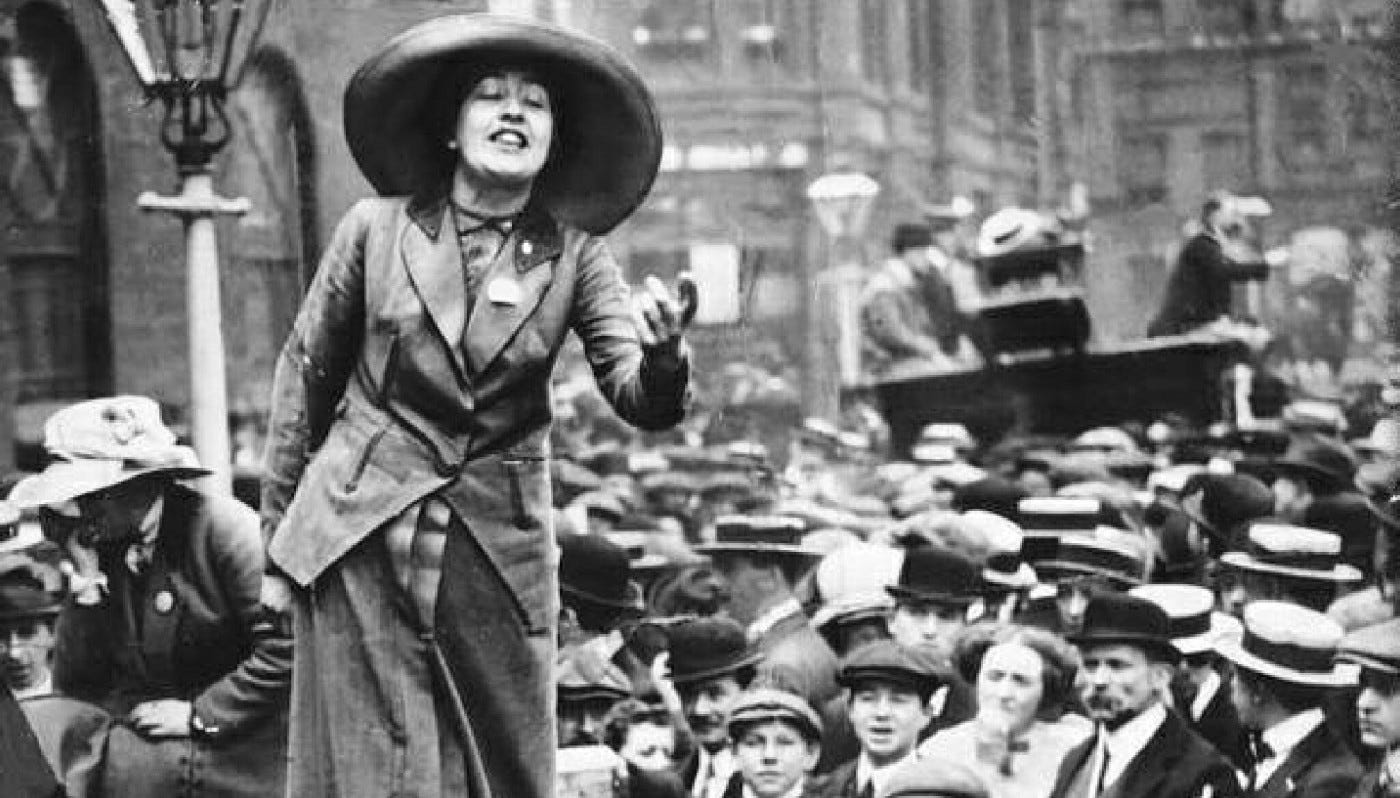
Alison Redmond-Bate was a Christian and a member of an organisation called the Faith Ministries. The photo above is of a suffragette by the way because my subject here is not specifically preaching the Gospel but Free Speech.
The Faith Ministries preached the Gospel on the streets. On 2 October 1997 Alison, her mother and one other woman were preaching on the steps of Wakefield Cathedral.
An anonymous couple complained about the preaching to Police Constable Tennant who was on foot patrol. He attended at the Cathedral. There was not much of a crowd. He warned the three women not to stop people but, since they were not actually stopping people, he moved on. Twenty minutes later PC Tennant returned to find that a crowd of more than a hundred had gathered. Some of the crowd were showing hostility towards the three women preachers. PC Tennant asked the women to stop preaching. When they refused, he arrested them for breach of the peace.
Alison was convicted. Alison appealed her conviction to the High Court.
The crucial question about ‘breach of the peace’ is where the threat is coming from. Is it coming from the preachers or from some in the crowd? Were the actions of the preachers calculated to provoke violent and disorderly reaction?
Commenting on the case of R v Nicol and Selvanayagam (1995), a case involving an animal rights protest, it was stated by Lord Justice Sedley giving the judgment in Alison’s case :
…the Court would surely not find a…complaint proved if any violence likely to have been provoked on the part of others would be not merely unlawful but wholly unreasonable - as, of course, it would be if the defendant’s conduct was not merely lawful but such as in no material way interfered with the other’s rights. A fortiori if the defendant was properly exercising his own basic rights, whether of assembly, demonstration or free speech.
The essential other dimension in this case was the Human Rights Act 1998 ( not at that date brought into force but the court placed great reliance on it and, additionally, Lord Justice Sedley felt that much of the rights contained in the Act were already enshrined in the common law ie. case law which has established and developed many principles of law not covered by legislation).
The two relevant Articles of the Human Rights Act are as follows:
“ Article 9
Freedom of thought, conscience and religion
1. Everyone has the right to freedom of thought, conscience and religion; this right includes freedom to change his religion or belief and freedom, either alone or in community with others and in public or private, to manifest his religion or belief, in worship, teaching, practice and observance.
2. Freedom to manifest one’s religious beliefs shall be subject only to such limitations as are prescribed by law and are necessary in a democratic society in the interests of public safety, for the protection of public order, health or morals, or for the protection of the rights and freedoms of others.
Article 10
Freedom of Expression
(1) Everyone has the right to freedom of expression. This right shall include freedom to hold opinions and to receive and impart information and ideas without interference by public authority and regardless of frontiers. This Article shall not prevent States from requiring the licensing of broadcasting, television or cinema enterprises.
(2) The exercise of these freedoms, since it carries with it duties and responsibilities, may be subject to such formalities, conditions, restrictions or penalties as prescribed by law and are necessary in a democratic society, in the interests of national security, territorial integrity or public safety, for the prevention of disorder or crime, for the protection of health or morals, for the protection of the reputation or rights of others, for preventing the disclosure of information received in confidence, or for maintaining the authority and impartiality of the judiciary.”
I often just quote part of Lord Justice Sedley’s judgment in this case ( with which Mr Justice Collins, who was on the judge’s bench with him, concurred) but I think it is worth widening out that quote.
“20. But turning to the facts of this case, I am unable to see any lawful basis for the arrest or therefore the conviction. … There was no suggestion of highway obstruction. Nobody had to stop and listen. If they did so, they were as free to express the view that the preachers should be locked up or silenced as the appellant and her companions were to preach. Mr. Kealy for the prosecutor submitted that if there are two alternative sources of trouble, a constable can properly take steps against either. This is right, but only if both are threatening violence or behaving in a manner that might provoke violence. Mr. Kealy was prepared to accept that blame could not attach for a breach of the peace to a speaker so long as what she said was inoffensive. This will not do. Free speech includes not only the inoffensive but the irritating, the contentious, the eccentric, the heretical, the unwelcome and the provocative provided it does not tend to provoke violence. Freedom only to speak inoffensively is not worth having. What Speakers’ Corner (where the law applies as fully as anywhere else) demonstrates is the tolerance which is both extended by the law to opinion of every kind and expected by the law in the conduct of those who disagree, even strongly, with what they hear. From the condemnation of Socrates to the persecution of modern writers and journalists, our world has seen too many examples of state control of unofficial ideas. A central purpose of the European Convention on Human Rights has been to set close limits to any such assumed power. We in this country continue to owe a debt to the jury which in 1670 refused to convict the Quakers William Penn and William Mead for preaching ideas which offended against state orthodoxy.
“21. To proceed, as the Crown Court did, from the fact that the three women were preaching about morality, God and the Bible (the topic not only of sermons preached on every Sunday of the year but of at least one regular daily slot on national radio) to a reasonable apprehension that violence is going to erupt is, with great respect, both illiberal and illogical. The situation perceived and recounted by PC Tennant did not justify him in apprehending a breach of the peace, much less a breach of the peace for which the three women would be responsible. No more were the Magistrates justified in convicting the appellant or the Crown Court in upholding the conviction. For the reasons I have given, the constable was not acting in the execution of his duty when he required the women to stop preaching, and the appellant was therefore not guilty of obstructing him in the execution of his duty when she refused to comply.”
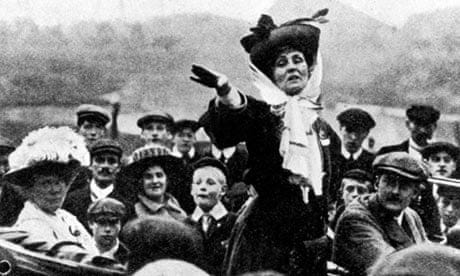
Emmeline Pankhurst
In conclusion, maybe some in the crowd at the steps of Wakefield Cathedral were inciting breach of the peace, but Alison and the other two women were not guilty of this and were simply taking part in and continuing the great British tradition of freedom of speech. Recent events ( see my updates) make us concerned about this vital cornerstone of democracy in Britain. We must continue to defend it.
Going through Andrew’s suggestions:
Repeal all hate speech laws
For the reasons given by Andrew, I totally agree.
Abolish ‘protected characteristics’
Any such abolition would effectively involve repealing the Equality Act. Quite a number of Terfs are in favour of this (eg. Kellie-Jay Keen and EDI Jester) but I feel that this is throwing the baby out with the bathwater. I do feel that the Act needs significant amendment. I can immediately say that the protected characteristic of ‘gender reassignment’ should be removed since it is meaningless! I will be doing a separate one off about the Equality Act.
I do, however, agree with Andrew (for the reasons he gives) that there should not be harsher sentences when a crime is said to be motivated by hate related to a protected characteristic.
Abolish or reform all quangos and government departments that have been ideologically captured.
For the reasons given by Andrew, I totally agree. For a start, let’s get rid of the College of Policing!
Clearer laws on incitement to violence.
One again, I agree and see my previous one off on this subject.
Introduce a UK equivalent of the First Amendment.
I do not think this is necessary as explained in my previous one off ( as copied above) on this subject referring to the common law and the Human Rights Act.
Please do let me have your comments and suggestions. My thoughts on all this are not set in stone, of course!! I know that the Party of Women ( who I am a member of) have a manifesto. Once I finish these one offs I will compare where I have got to with that manifesto. BTW I will be attempting to look at manifestoes/policies relating to the upcoming Gorton & Denton by-election in Manchester.
Let’s have some appropriate music!

#BeMorePorcupine
#SaveFreeSpeech
A very important piece, thanks Dusty. Freedom of speech is fundamental for the fair and just running of society. Without it, problems cannot be solved, creativity is stifled, human interaction is curtailed and fear prevails. If our freedom to speak is curtailed in law, or through fear of cancellation or abuse, then we can be silenced by anyone who disagrees with us or is offended by our opinions….as we’ve seen so often. The very last thing that a democracy should be doing is bringing in laws to curtail speech. That is the pathway to authoritarianism and sadly Labour and the EU are galloping down that road.
I agree with most of your points although I’m still on the fence about the Equality Act. I’d prefer for the state to keep out of our lives as much as possible. I’m veering towards thinking that we should all have rights as human beings and that should be enough- but I’m useless at matters of law so I’m happy to hear both sides.
#KeepSpeaking